

Elements
Add Avatars, backgrounds, images, videos, text, and shapes to your scenes.
Element types
You're able to add the following elements to the canvas:

| Element | Description |
|---|---|
| Avatar | Search for and add a stock avatar from Synthesia's library, or one of your own custom avatars (e.g. a Studio or Personal avatar). All the avatars available for use with your account will be visible from the Avatars page in your library. |
| Text | Text elements. |
| Shape | Squares, arrows, circles, and more. |
| Motion | Add motion graphic elements to your video. |
| Media | Images, videos, animated GIFs, icons, Lottie animations, and logos. |
| Captions | Add stylized dynamic captions to your video. |
| Interactivity | Add buttons, quizzes, menus, and branching paths to your videos. |
| Record | Add a screen recording to your scene. |
Element settings
Some settings apply to all types of elements, and each type of element has its own respective settings. Selecting an element in the canvas will reveal its unique settings in the inspector panel.
Note:For the full set of keyboard shortcuts for working with elements—including grouping, layering, duplicating, and aligning—see Manipulating Elements in Keyboard Shortcuts.
Lock and unlock elements
Locking an element prevents the element from being moved, resized, or rotated on the canvas.
To lock an element:
- Select the element on the scene.
- Once selected, right-click the element and select
Lockfrom the menu drop down.
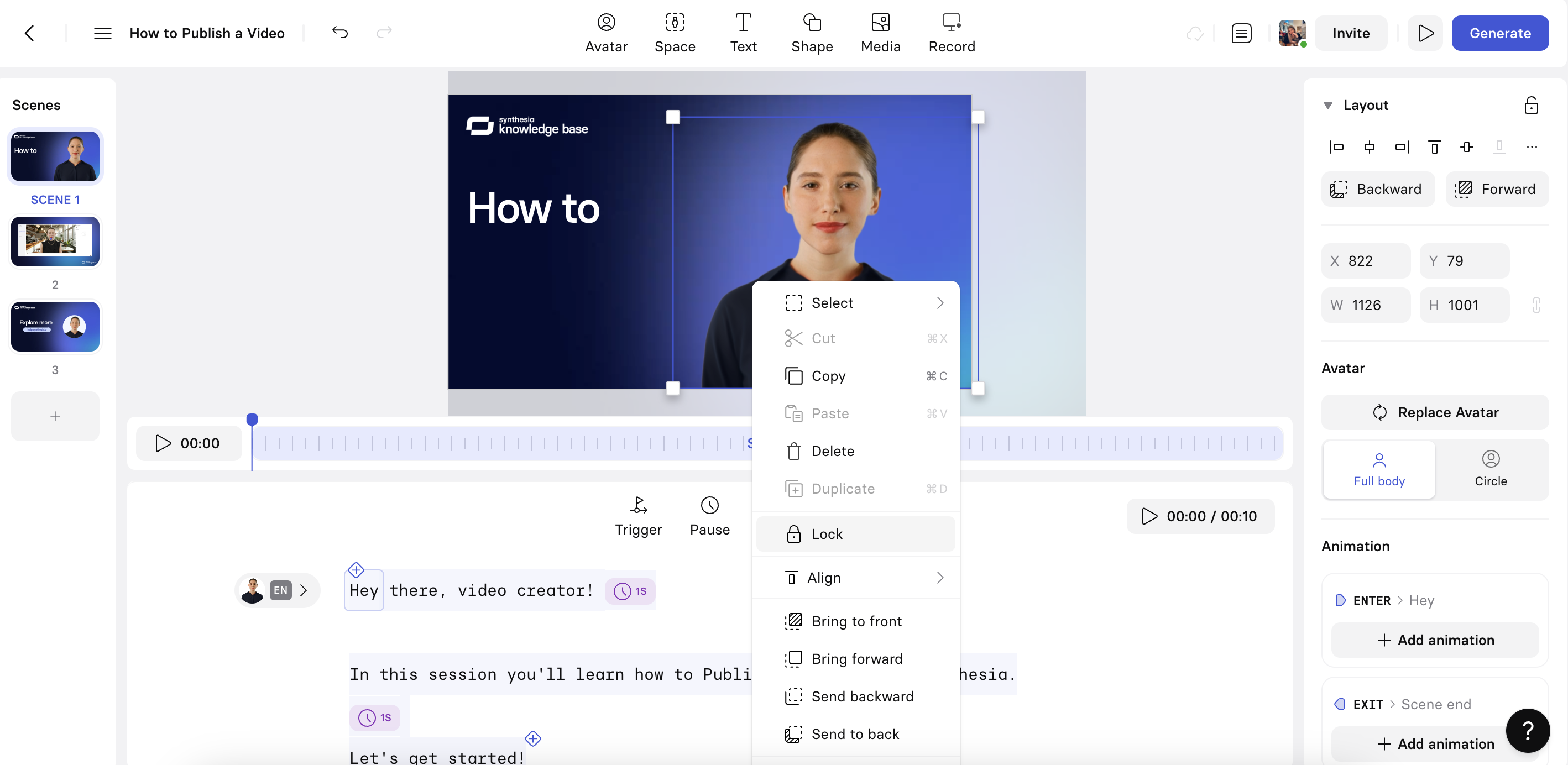
To unlock an element:
- Select a locked element on the scene.
- Once selected, right-click the element and select
Unlockfrom the menu drop down.
You can also toggle lock on the selected element(s) with ⌘/Ctrl + Shift + L.
Selecting elements
- To select a single element, click on it.
- To select/deselect additional elements, hold down the
Shiftkey and click on each element you'd like to select. - To select all elements in a scene, click anywhere on the canvas and press
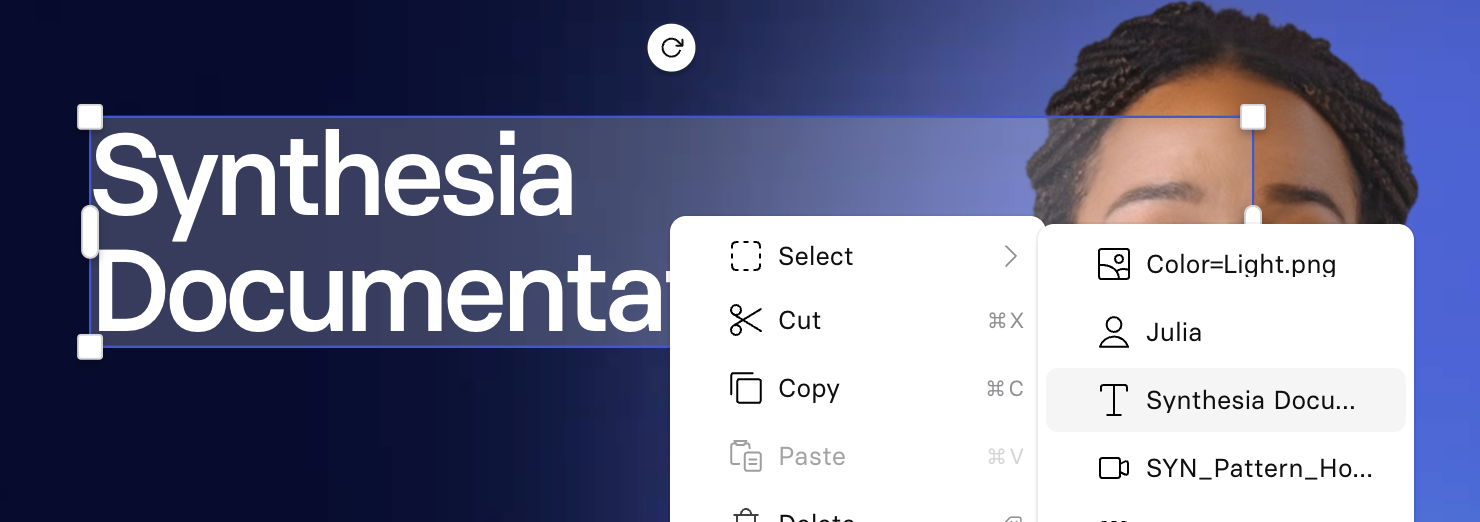
⌘ + A(Mac) orCtrl + A(PC). - To select a specific element when multiple elements overlap:
- Right-click anywhere on the canvas.
- Click on the
Selectoption at the top of the menu. The elements in the list are displayed in the order that they are layered in the canvas. The first item is the top-most element in the foreground, and the last item is the element that's furthest in the background. - Hover any element from the list of elements displayed to highlight it on the scene.
- Click on an element from the list to select it.
Contextual menus
Selecting an element on the canvas also opens a contextual menu, giving you quick access to some of that element's most commonly used settings without opening the full Design tab in the inspector panel.
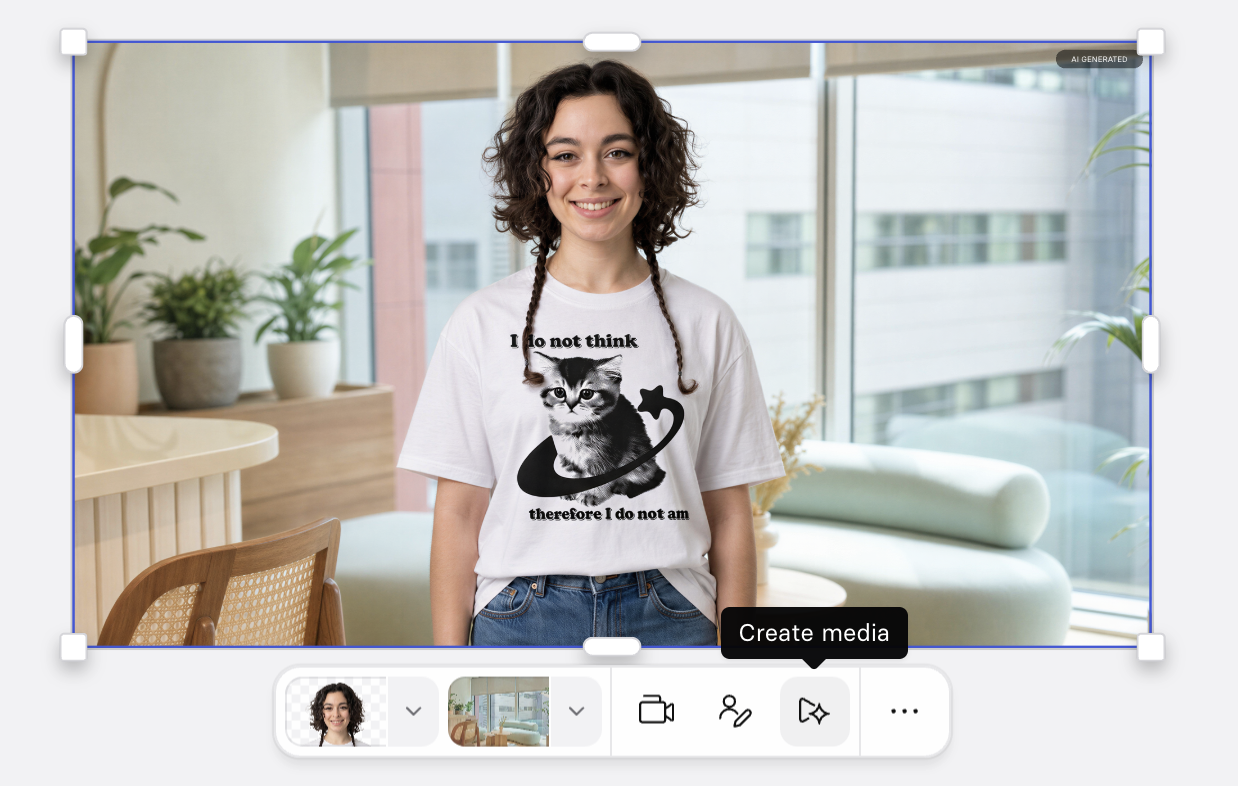
Contextual menu for a customizable avatar
The options shown depend on the element type. For example:
- Text: If a preset text style is applied (for example, from your brand kit), simple options like text alignment. Otherwise, font settings like family, size, and color.
- Shape: Change the fill color.
- Avatar: Change the outfit, select a different space, jump straight into customizing a new outfit, or generate B-roll footage.
Each element type has its own set of contextual menu options—see each element's own page for details.
Every contextual menu also has a three-dot (⋯) icon at the right. Selecting it opens the same menu you'd get by right-clicking the element or group instead, which also includes:
Use as background: sets a media element (image or video) as the scene's background directly.Arrange: the same layer-ordering options described in Positioning, sizing, and rotating elements below.Flip: the same horizontal/vertical flip described below.Show layersAdd comment
Selecting multiple elements also opens a contextual menu for that selection, which includes a Tidy button (see Tidy below).
Positioning, sizing, and rotating elements
Select an element to reveal layout controls in the Design tab of the inspector panel, in addition to dragging, resizing, and rotating it directly on the canvas:
- Alignment: Align the element to the left, horizontal center, or right, and to the top, vertical center, or bottom.
- Layer order: Move the element backward or forward in the stacking order. Also available by right-clicking the element and selecting
Arrange. - Position: Set the element's exact X and Y position numerically.
- Size: Set width and height numerically. Select the link icon next to these fields to constrain their proportions, so resizing one dimension scales the other to match.
- Rotation: Drag the rotate handle that appears next to a selected element on the canvas, or enter a precise degree value in the inspector panel.
- Flip: Flip the element horizontally or vertically. Also available by right-clicking the element and selecting
Flip.
Note:If you select multiple elements before aligning them, they're aligned relative to each other rather than to the canvas. For example, aligning left moves every selected element to match whichever one is furthest left. With a single element selected, alignment is relative to the canvas itself.
Tidy
Select multiple elements to open a shared contextual menu, then select Tidy to automatically align and evenly distribute them in one click, horizontally or vertically, left-aligning any text (handy for bullet lists). This replaces manually choosing an alignment and then a distribution option as two separate steps.
Note:Tidy works on non-rotated elements, or elements rotated to an angle divisible by 90°. It isn't offered if tidying would cause the selected elements to significantly overlap.
Grouping elements
Group elements together to move, resize, and animate them as a single unit. Any element type can be grouped, except avatars.
To group elements:
- Select multiple elements (see Selecting elements).
- Group them with
⌘/Ctrl + G, or right-click the selection and selectGroupfrom the menu.
Ungroup elements with ⌘/Ctrl + Shift + G, or right-click the group and select Ungroup from the menu.
Once grouped, you can:
- Apply animations and effects to the group as a whole, since groups of elements are a valid animation target.
- Change the group's position, size, and rotation as a single unit (see Positioning, sizing, and rotating elements).
- Tidy the group's contents, even if it contains a mix of element types.
If every element in the group shares the same type, or the same applicable settings, you can also edit those shared settings for all of them at once. For example:
- A group of only non-circular shapes lets you adjust all their border radiuses together.
- A group of only shapes lets you adjust all their colors and any text settings together.
Which settings you can edit in bulk depends on what's in the group—elements only expose the settings they have in common.
Copying elements to other scenes
Copy any element and paste it into other scenes, adding it in the same position each time (you can adjust this per scene afterward). This works for any element type, including captions and interactive elements.
- Select the element and copy it (
Ctrl/Cmd + C, or right-click and selectCopy). - Select the scenes to paste it into, in the Scenes panel. This works like standard file selection controls in most file browsers:
- To select specific scenes: Click a scene to select it, then
Ctrl/Cmd+ click any other scenes to add them individually, in any order. - To select a range of scenes: Click the first scene, hold
Shift, then click the last scene, to select a contiguous range of scenes. - To select all scenes: Click any scene, then press
Ctrl/Cmd + Ato select all scenes.
- To select specific scenes: Click a scene to select it, then
- Paste the element (
Ctrl/Cmd + V, or right-click and selectPaste) to apply it to every selected scene at once.
This is a fast way to apply consistent branding elements, like a logo, disclaimer, or caption style, across an entire video without repeating the setup on each scene individually.
Replacing elements in bulk
For avatars and media elements (images and videos), replacing one instance in a scene shows a toast notification with a Replace all option, letting you apply that same replacement across every other scene using that avatar or media element.
See Avatar and Media for details.
Animations and effects
Apply animations and effects to bring your elements to life: entrances, exits, emphasis, avatar camera swaps, and more.
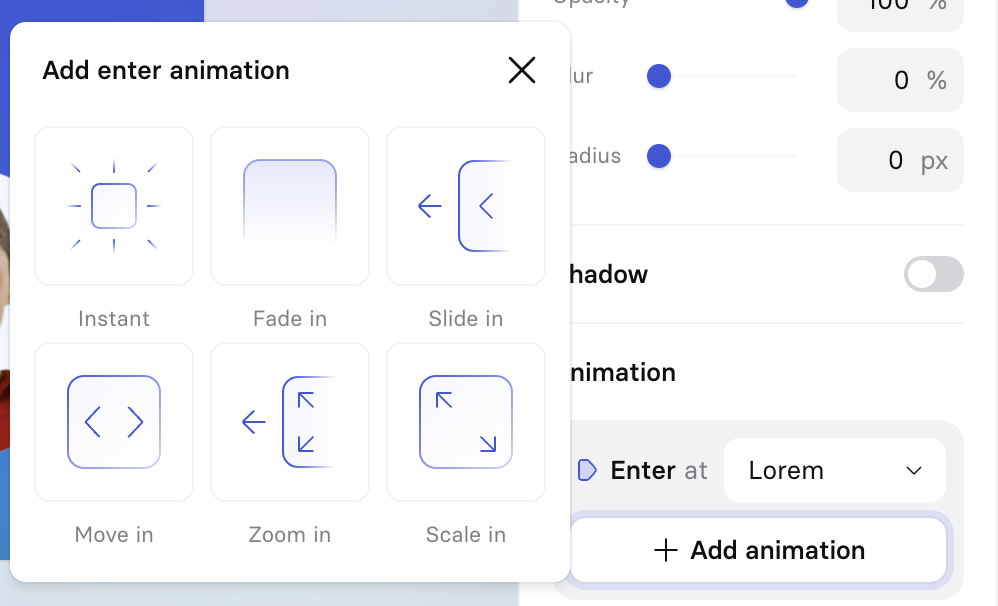
See Animations & Effects for the full list of animations, effects, and settings available for each element type.
Updated 2 months ago