

Interactivity
Add buttons, quizzes, menus, and branching paths to your videos to drive higher completion rates and guide your viewers to take action.
Interactivity is available on Pro plans and up.
- Buttons, branching menus, and navigation features are available on Pro plans and up.
- Quizzes and SCORM export are available on Enterprise only.
Synthesia's Interactivity feature enables creators to design dynamic, clickable videos with branching pathways and knowledge checks:
- Add buttons: Convert text and shape elements into buttons that open URLs or jump to other scenes, enabling the creation of non-linear branching experiences and navigation menus.
- Create knowledge checks and quizzes: Add single-answer and multiple-answer questions for knowledge checks and quizzes with or without pass/fail criteria.
Note:Only videos shared via Synthesia's video player can be interactive. Interactivity is made possible with Synthesia's video player—it's available for Synthesia videos shared via the share page link, iframe embeds, and SCORM packages. Downloading interactive videos is not supported (an
MP4file on its own is incapable of having buttons).
Creating interactive videos
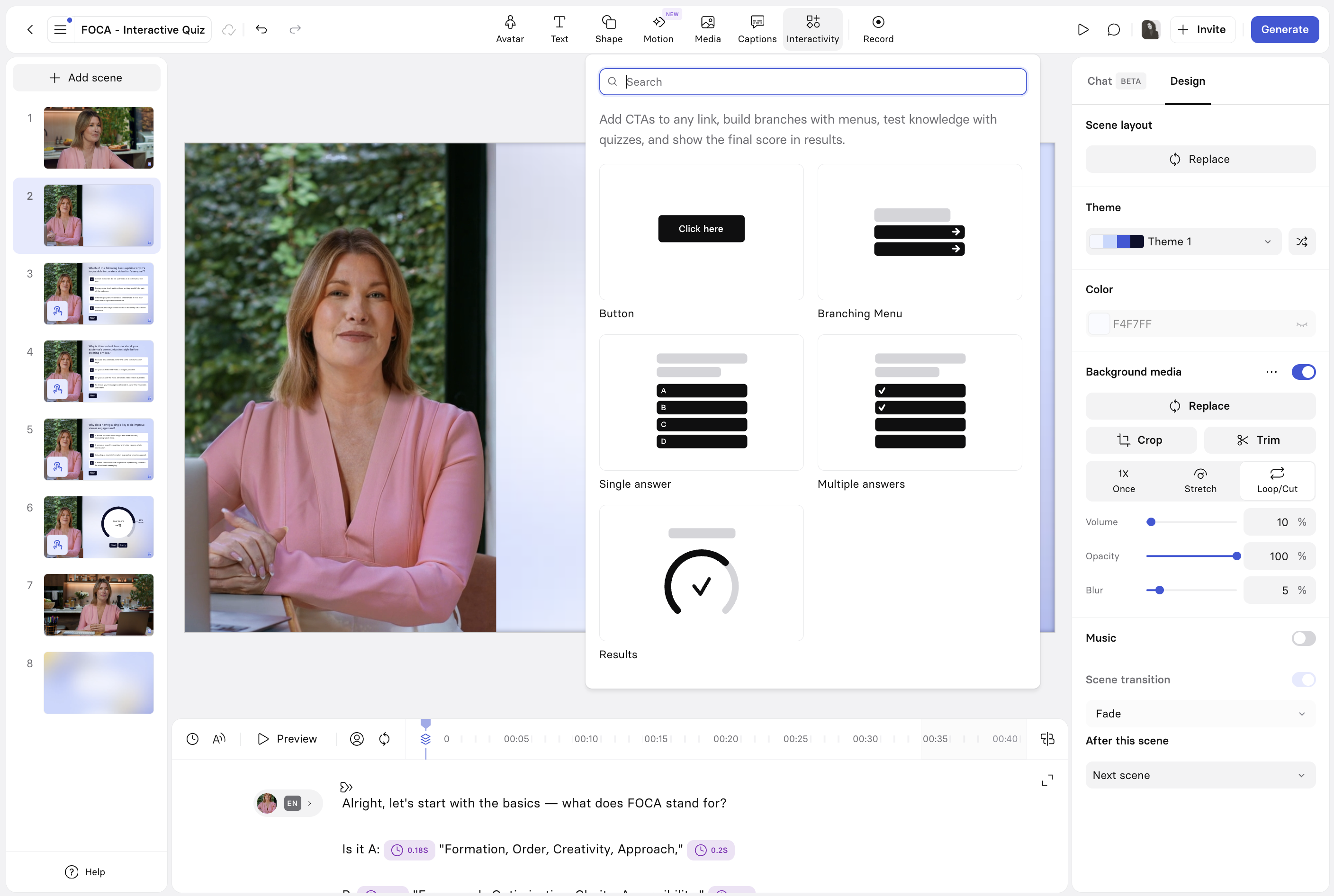
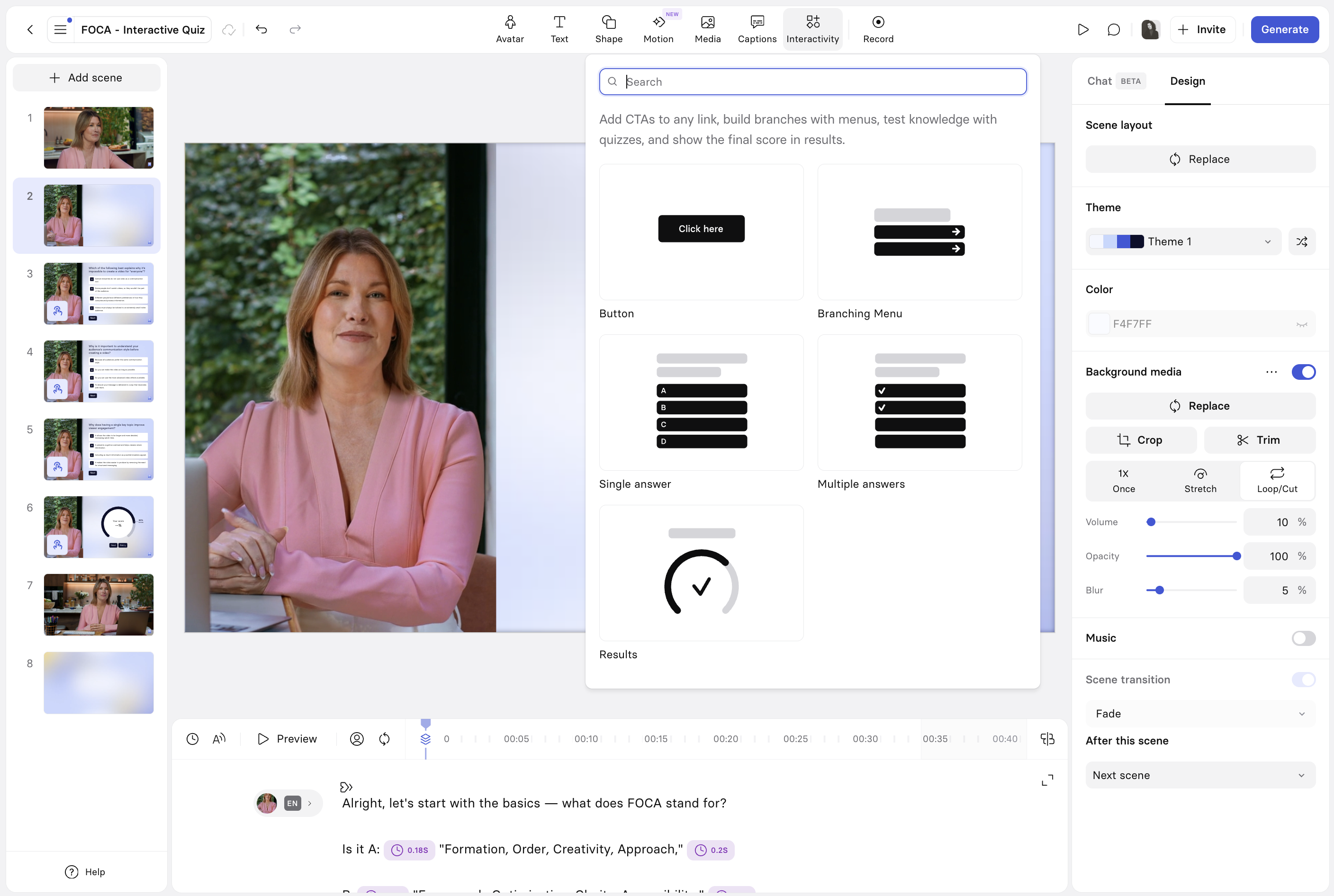
Select the Interactivity button in the toolbar to add ready-to-use components to your canvas: Button and Branching Menu components for buttons, and Single answer, Multiple answers, and Results for questions and quizzes. Your workspace's Brand Kit colors and fonts are automatically applied to them, and you can adjust styling for each from the inspector panel as necessary:
Buttons and menus can also be created from scratch by enabling the Interactivity toggle for a text/shape element or group of text and/or shape elements in the inspector panel.
Buttons
Text and shape elements, and groups of text and/or shape elements, can become buttons. See Text and Shape for how to style them.
There's no limit to the number of interactive elements you can add to a particular scene, but we recommend keeping things simple to provide the best viewer experience.
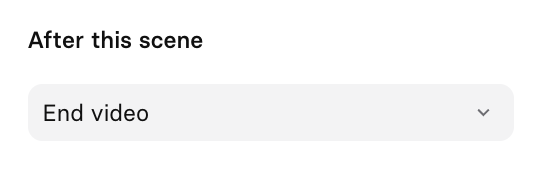
Important:If you're building an interactive video with buttons and no quiz, remember to set
End videoon whichever scene should mark the video as finished, using theAfter this scenesetting at the bottom of the inspector panel for the scene—see Branching videos. Without this, there's no way for Synthesia, or your LMS, to know the video is complete.This is separate from how completion works for quizzes, which use a Results component instead—see SCORM export.
To start from a ready-made button, select the Interactivity button in the toolbar and choose Button or Branching Menu from the picker—both come pre-styled with your Brand Kit. Otherwise, build one from scratch out of a text or shape element:
Create a button
-
Add a text or shape element to the canvas, or select one you've already placed there (or a group of them).
-
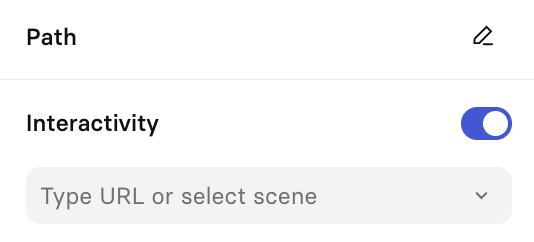
From the inspector panel, toggle on the interactivity option:
-
Choose an action for the button click to trigger:
-
Open URL: To navigate the viewer to a URL, paste a link directly into the interactivity input field and select
Set as URL.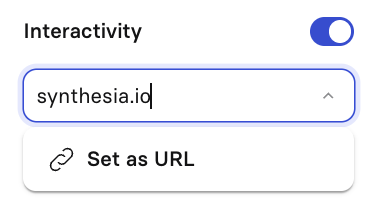
-
Jump to Scene:
-
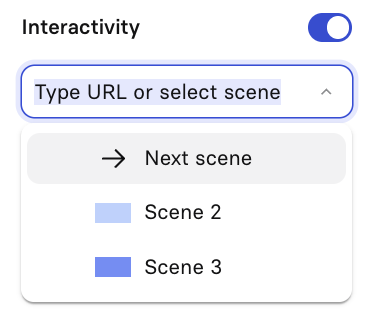
If the button should take the viewer to the next scene in the video, select the interactivity input field and choose
Next scene. -
Otherwise, select a specific scene for the viewer to be directed to—it can be any of the previous or following scenes in the video.
-
-
Optionally, enable
Wait for clickto pause the video until a viewer interacts with the button. WithWait for clickenabled, viewers can't pause or skip the scene.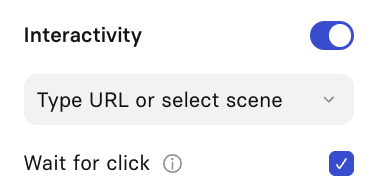
-
Note:Only text and shape elements, and groups of text and/or shape elements, can become buttons. A group of elements that includes a media element, such as a video, can't be interactive.
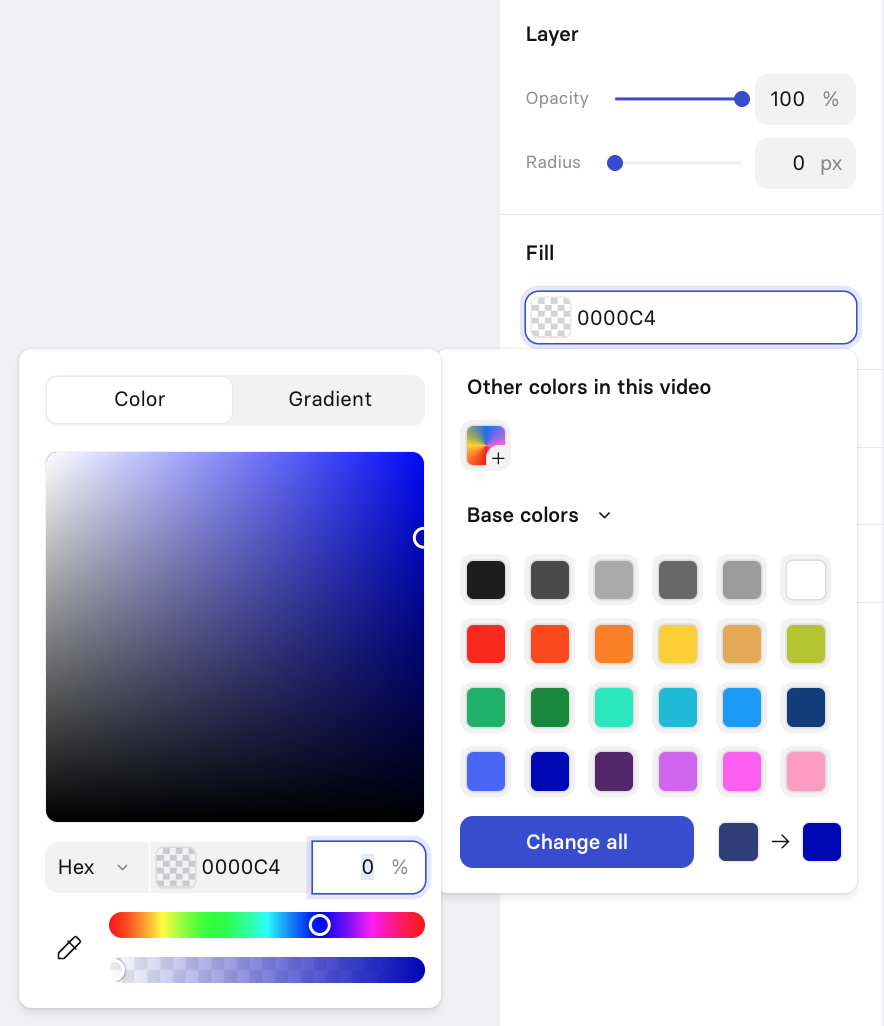
Pro tip:If you'd like to simulate interactivity for an element that isn't text or a shape, like a media element, place a shape on top of the media element and adjust the transparency of the shape's fill color to 0%. Then, enable interactivity for the transparent shape and adjust settings as desired. The opacity of the layer itself must remain at 100%.
Questions and quizzes
Questions and quizzes are an Enterprise plan feature.This includes single answer questions, multiple answer questions, and results.
You can add interactive questions to your videos to create knowledge checks and track viewer understanding. Questions can be grouped into quizzes with scoring and pass/fail criteria—perfect for training and eLearning content.
Interactivity panel
Add a question to your video
-
Select the
Interactivitybutton in the top toolbar. -
Select either:
- Single answer: multiple-choice question where there is only a single correct answer.
- Multiple answer: multiple-choice question where there is more than one correct answer, and every correct option must be selected, and no incorrect ones, for the response to count as correct—there's no partial credit for selecting some but not all of the correct options.
-
When added to a scene, question components snap to the right half of the canvas but can be freely resized and moved.
-
Edit the question and answer text by selecting into the component.
-
Add additional answer options by selecting the
+button under the bottom-most answer option. To delete an option, hover over it and select the trash icon that appears to the left of the answer.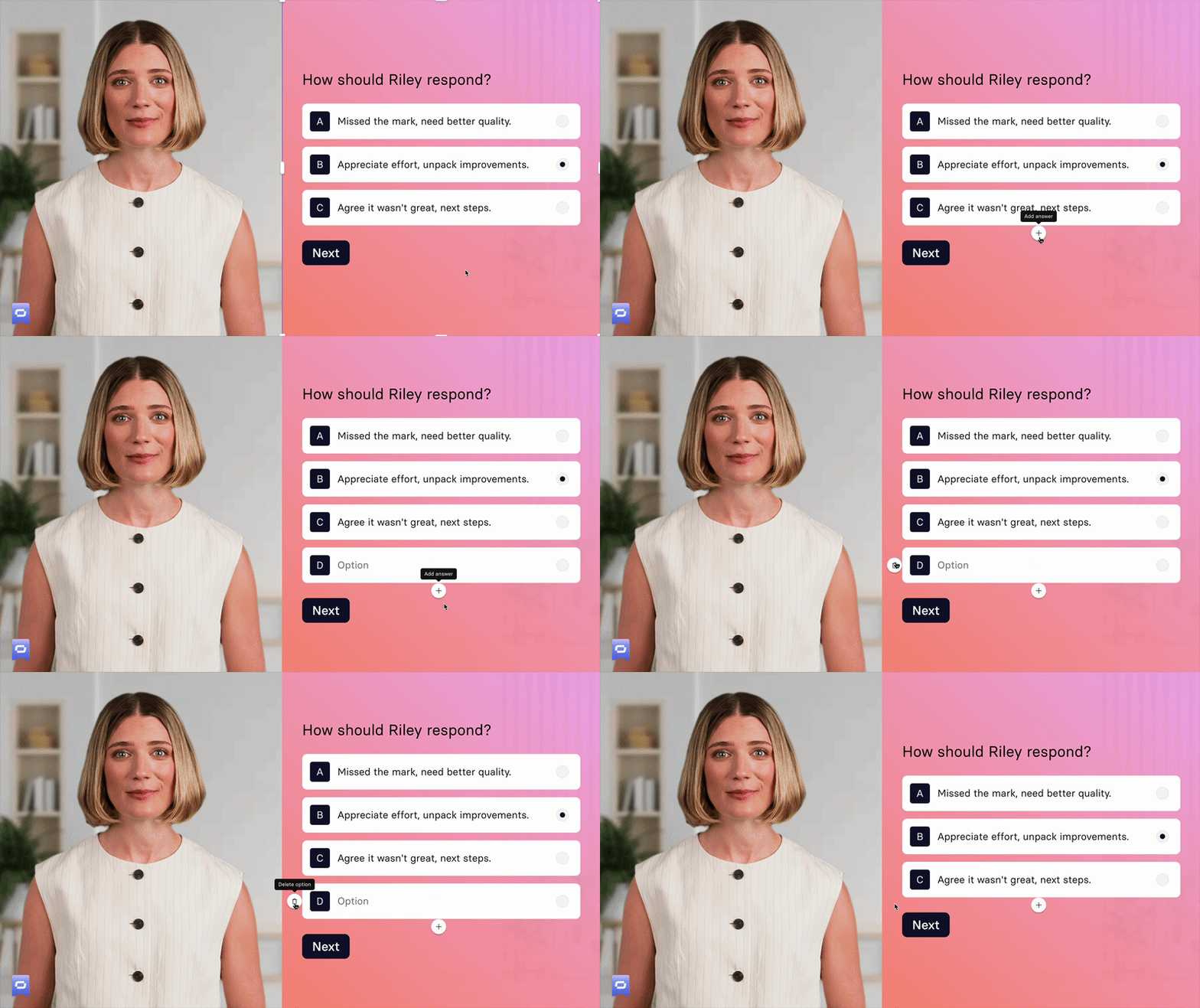
-
Mark the correct answer(s) using the radio button (for single answer) or checkboxes (for multiple answer).
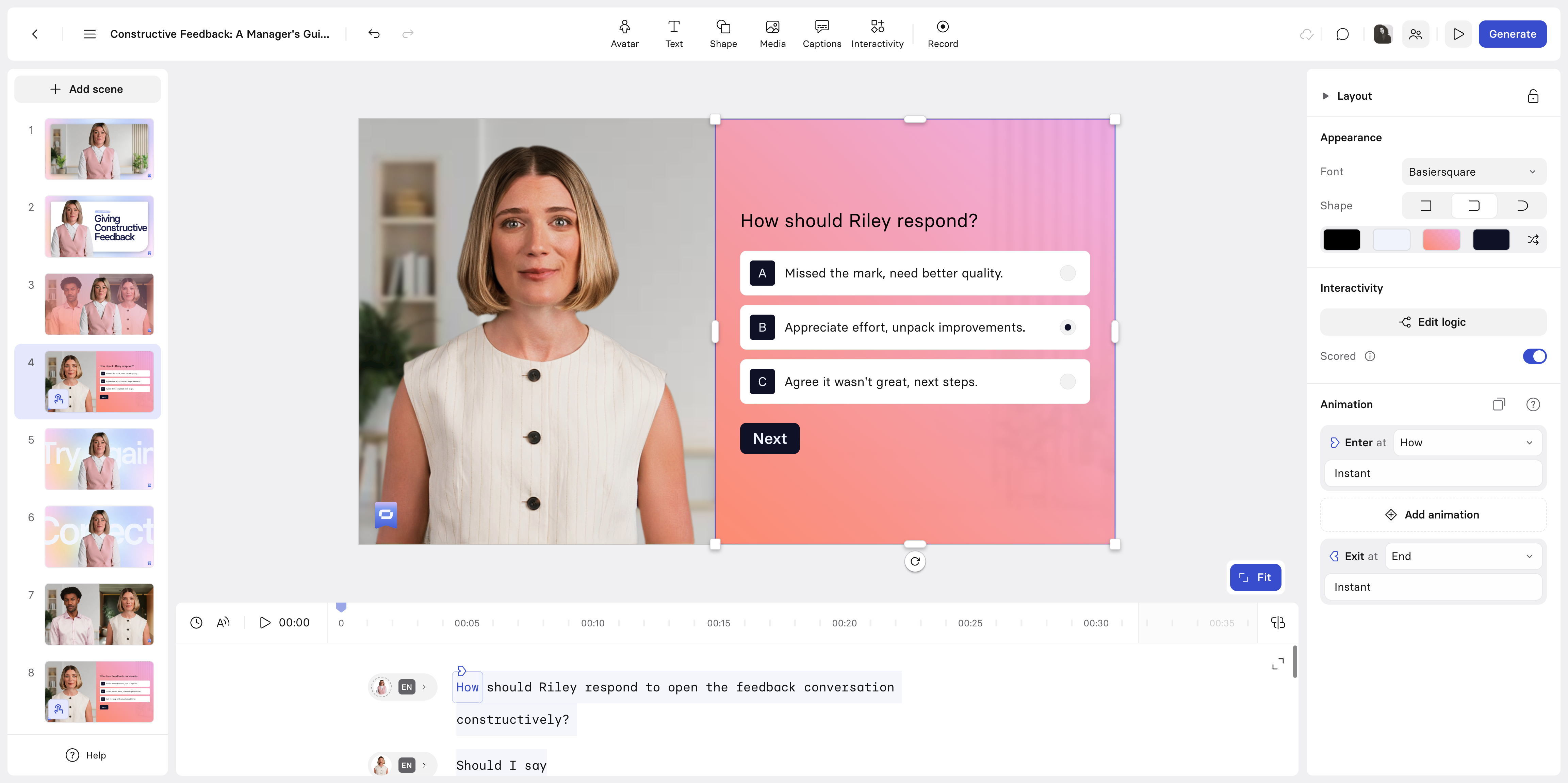
-
Customize the appearance using the three styling options: font family, shape, and color. You can also resize, crop, rotate, and move the question component.
Note:
- You can only add one Single answer or Multiple answer component to each scene.
- You'll need to add at least one Single answer or Multiple answer component to your video before you can add a Results component to your video.
- You can only add one Results component to your video.
Scoring and practice mode
Every question is scored by default: it counts toward the quiz's overall score, and viewers don't see whether their answer was correct until they reach the results component.
Toggle off Score for a question, in the Interactivity section of the inspector panel, to enable practice mode instead. This does two things at once:
- Excludes the question from the overall quiz score.
- Shows the viewer immediate correct/incorrect feedback after they submit their answer.
These aren't two separate settings—turning off Score is what causes both changes together. Practice mode is useful for formative assessments or learning checkpoints that shouldn't affect the final score.
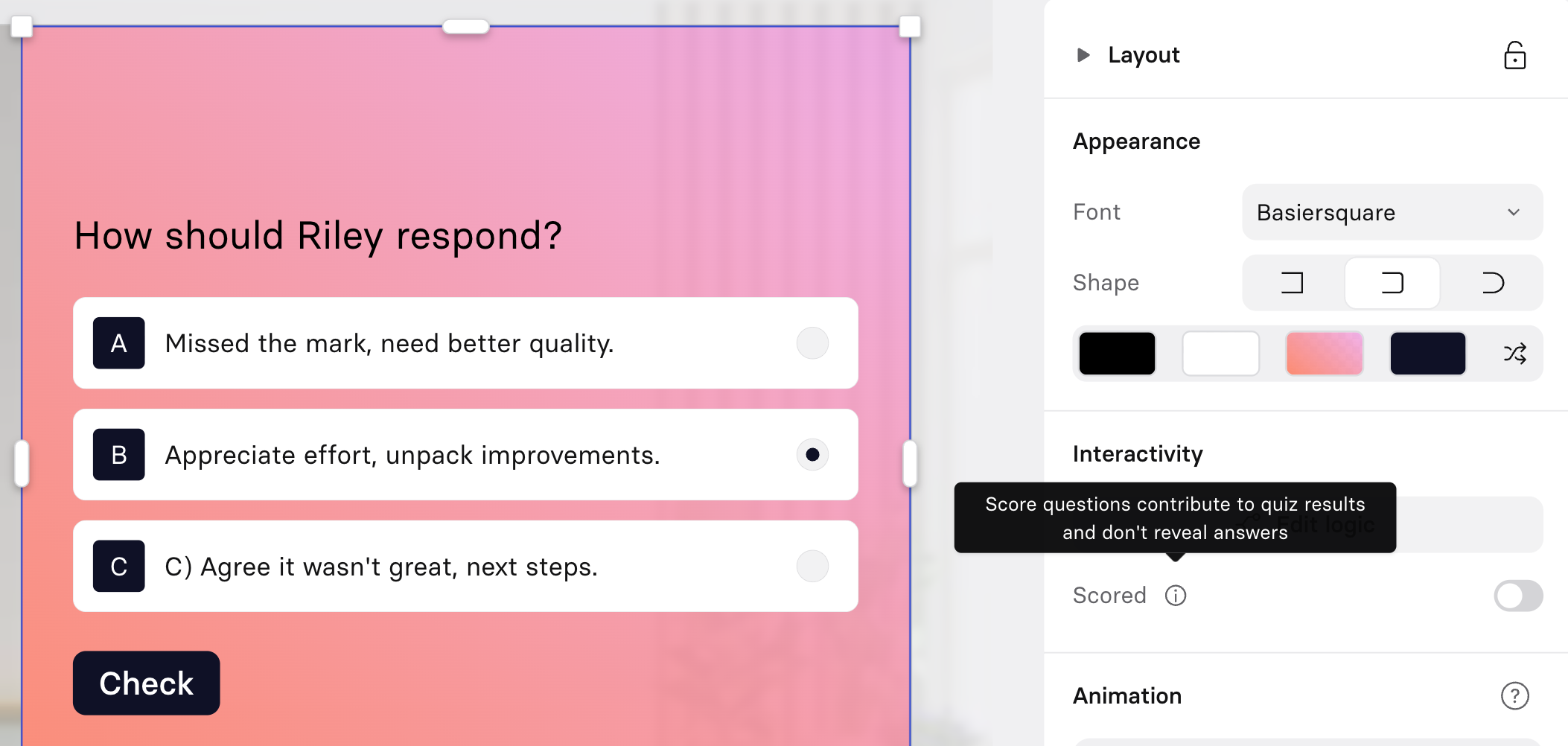
A single answer quiz component with the Scored option toggled off to enable practice mode
Results component
The Results component displays quiz outcomes, and can be added once per video.
Reaching the scene with the Results component is what marks a quiz video as complete—it's the quiz equivalent of setting End video on a non-quiz interactive video (see Branching videos). Without a Results component, a quiz has no way to signal that the viewer finished it, no matter how many questions they've answered.
See SCORM export for more detail on how completion, pass/fail, and question responses are reported to your LMS for videos with interactive elements and quizzes.
To add a Results component:
- Add the Results component from the Components menu.
- In the inspector panel, define the pass criteria—the percentage of scored questions a viewer needs to answer correctly to pass (for example, 80%). This is calculated only from questions with
Scoreturned on; practice-mode questions aren't counted in it. - Optionally, enable
Allow retry, which adds a retry button that takes viewers back to the first quiz question in the video, letting them reattempt every question.
Note:Pass criteria and video completion are two different things, and setting one doesn't affect the other:
- Completion is always reaching the scene with the Results component (or, for non-quiz interactive videos, the scene set as the end of the video). This is fixed—there's no percentage to configure for it.
- Pass criteria is the score threshold you set here, and only affects whether the quiz is marked passed or failed once the viewer reaches that scene. The Results component's pass criteria is a separate number that governs pass/fail, not completion.
Edit logic with conditional statements
Logic can be edited for both question and results components. The default logic is always to navigate to the next scene, but you can use conditional logic to control what happens based on answers submitted and full quiz performance:
- Always: A statement that always executes (can't be combined with If/else).
- If/else: Create conditional branches based on quiz answers or scores.
- You can stack multiple If statements by adding more rules.
- Within each If statement, you can append multiple conditions using AND operations.
For example:
- If editing logic for a question component, you can use conditional statements to provide learners with guidance upon answering that question incorrectly, and let them proceed to the next question only once they answer correctly.
- If editing logic for a results component, you can direct them to a coaching or feedback scene if they don't pass the quiz.
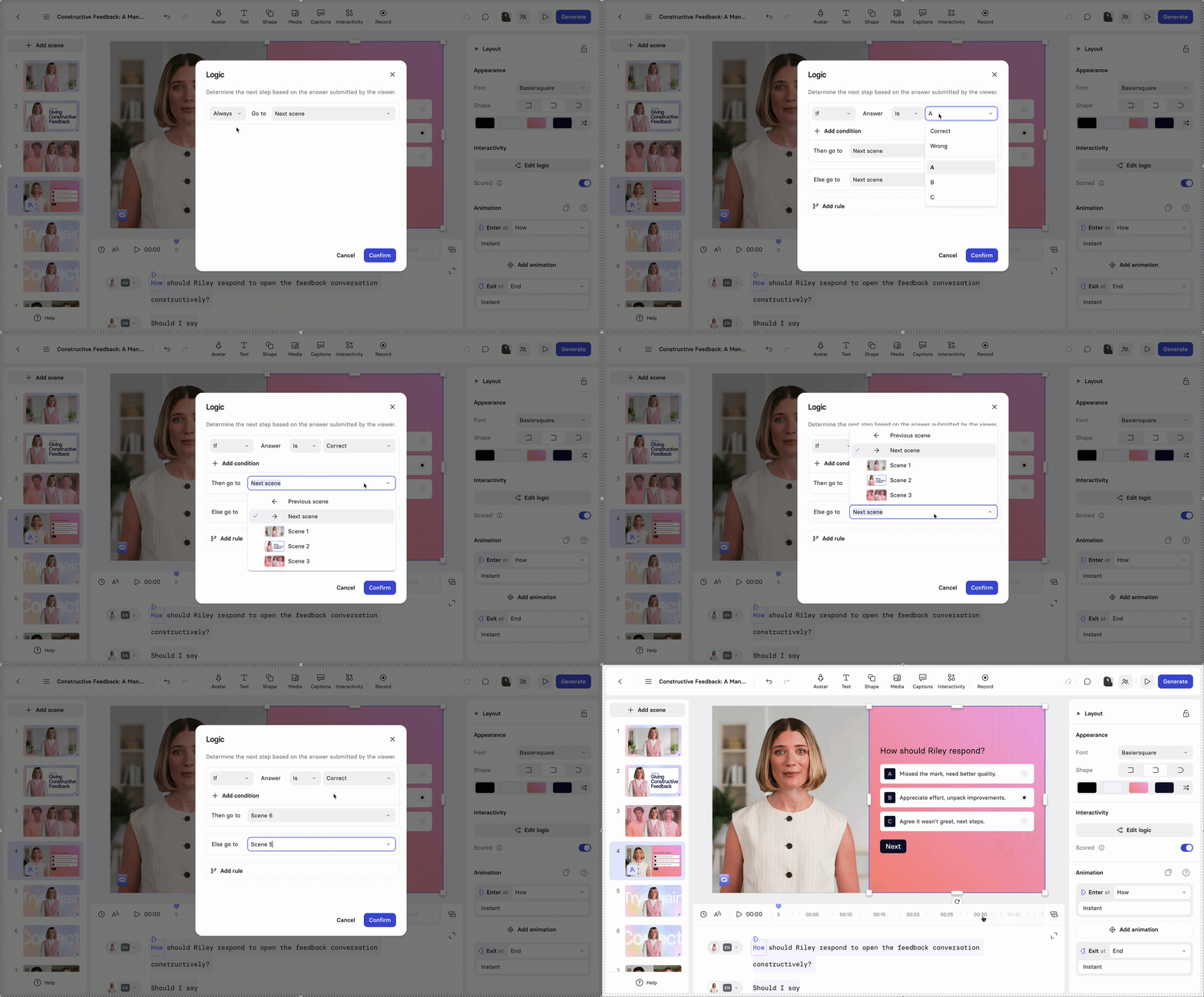
Editing logic for a single answer question component
Branching videos
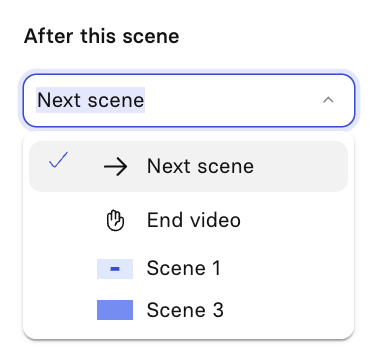
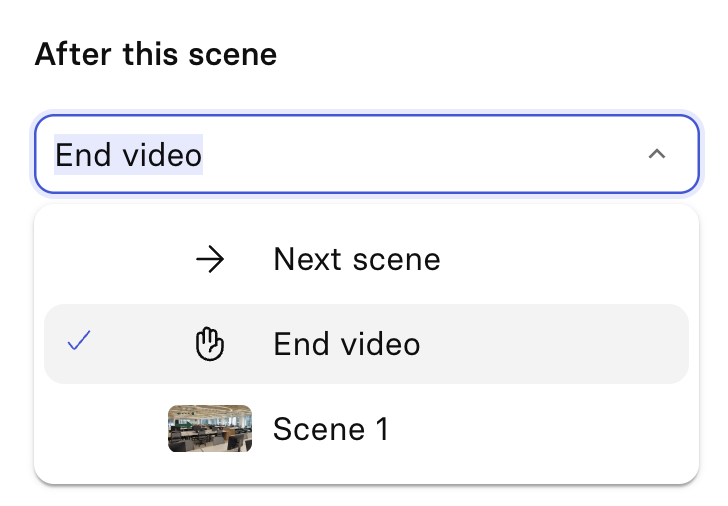
Unless a scene has Wait for click enabled for one of its interactive elements, it has an After this scene setting available in the inspector panel. This setting defines the path a video takes when the current scene finishes.
The available options for After this scene are:
Next scene: Direct the viewer to the next scene in the video.End video: Set the current scene as the final scene of the video.- A specific scene, listed by its position (
Scene 1,Scene 2,Scene 3, and so on)—it can be any of the previous or following scenes in the video. Custom scene names aren't reflected in this list.
Note:Setting
End videoon a scene is what marks a non-quiz interactive video as complete—this drives completion everywhere it matters, including video analytics and SCORM export to your LMS. This also applies if the video has question components but no Results component:End videostill handles completion on its own, since a Results component is only needed for reporting a scored pass/fail, not for completion itself.
Use a combination of scene navigation settings and buttons to make your videos feel like a conversation or guided journey.
- Use the
After this scenesetting to create a path (or paths) of scenes. - Add buttons to let users choose different paths by jumping to the scenes that start those paths.
Preview your interactive video
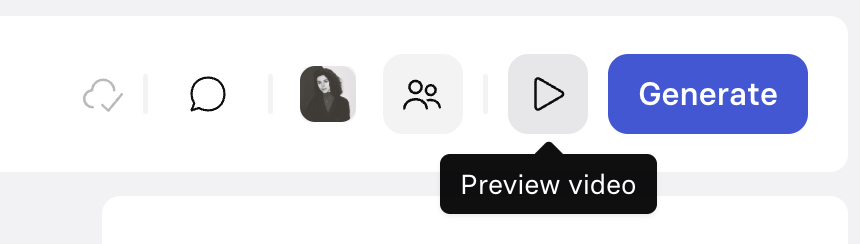
To verify that you've set up all your branches, buttons, questions, results, and logic settings correctly, launch a full interactive preview of your video from the Preview video (▶️) button at the top-right of the toolbar to test it out:
Sharing interactive videos
Interactive video player
Interactive elements enhance how viewers engage with your video in the Synthesia player:
- Buttons are visually marked with a shimmer effect during playback and by a dot on the timeline.
- Scene-based interactivity, like buttons set to
Wait for clickor a question, changes the viewing behavior:- The timeline is hidden to prevent skipping ahead, but the viewer can still restart the scene from the beginning, or pause/play it.
- Playback is paused until the viewer either selects a button, submits a response to a question, restarts the scene, or navigates back to the previous scene.
- If a viewer navigates backward in the video using player controls, they see the submitted state of previously answered questions (they can't change their answers unless retry is enabled).
- If a viewer uses the
Retrybutton on the results component, they can reattempt all quiz questions.
Accessibility
Interactive elements include ARIA labels and are keyboard-navigable. Viewers can use the Tab and Shift + Tab keys to cycle through clickable buttons, ensuring accessibility for keyboard-only users.
Pressing Tab focuses the next interactive element, while pressing Shift + Tab focuses the previous interactive element.
Multilingual playback
If you translate your interactive video using Synthesia, all translated versions are available through Synthesia's multilingual video player. Viewers are shown the appropriate translation based on their browser settings, and can switch between available languages at any time. This ensures your interactivity works seamlessly across different languages and provides a unified experience for global audiences.
Note:Viewers can only switch between translations during a scene that's non-blocking (the interactive elements in the scene don't have
Wait for clickenabled, or there are no questions in the scene). Switching between translations resets progress in the video.
SCORM export
Interactive videos can be exported as SCORM packages to publish in your LMS (learning management system).
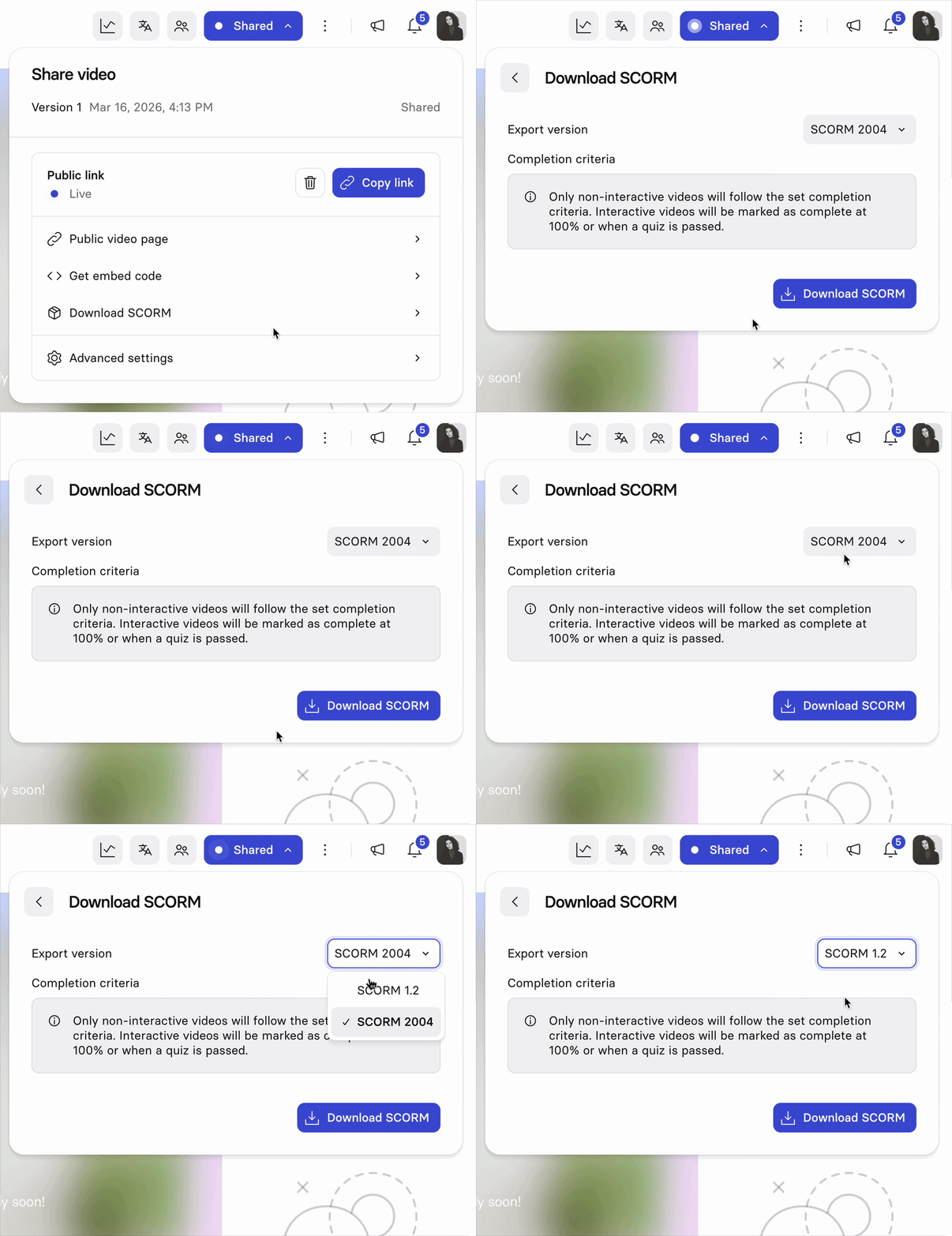
Interactive videos have a set completion rate of 100%. An interactive video is marked as complete only when the learner reaches the scene that has been designated as the end of the video, or, for a video with a graded quiz, the scene with the results component.
For interactive videos with quizzes
When your interactive video includes quiz questions, Synthesia reports the following information via SCORM:
- Completion status: Set to "completed" when the viewer reaches the scene with the results component.
- Success status: Set to "passed" or "failed" based on whether the viewer met the pass criteria defined in the results component.
- Score: Reported as a percentage between 0 and 100.
- Question responses: Each response and its correct/incorrect status are reported individually.
For interactive videos without a results component
For videos with buttons only, and videos with question components that don't have a results component added, use the After this scene setting in the inspector panel to set a scene as the end of the video, for it to be marked as complete in your LMS (and in Synthesia analytics).
Note:Without a scored quiz and results component, your LMS shows the video as complete (or passed) but reports a score of 0, since there's no score data to send. This is expected, not a bug—if you need a numeric score to show in your LMS for audit or reporting purposes, make it a scored quiz with a results component.
Video analytics for interactivity
Interactive videos support a range of analytics that help you understand how viewers engage with your content. Which tabs and metrics you see depends on whether your video has buttons, a quiz, or both—see Video analytics for the full breakdown by video type.
Adoption
Interactive videos with buttons (no quiz) only show the Adoption tab. Button-specific metrics live there too, under Engagement:
- Button CTR: The percentage of interactivity button impressions that resulted in a click.
- Button impressions: The number of times an interactivity button was displayed.
Questions
Videos with quizzes also show a Questions tab, with four quiz-specific metrics:
- Question attempts: Total number of times viewers responded to a question.
- Question pass rate: Percentage of correct responses relative to all responses.
- Quiz attempts: Total number of times viewers attempted to answer the quiz.
- Quiz pass rate: Percentage of quizzes passed relative to quiz completions.
These metrics help you identify where viewers struggle and improve your training content accordingly.
Results
Videos with quizzes also show a Results tab, with per-learner scores, a score distribution, and a filterable learner table. See Results for the full breakdown, including how to export the raw data.
Updated 1 day ago