

The Synthesia editor
Use the Synthesia editor to customize, refine, and perfect every aspect of your video.
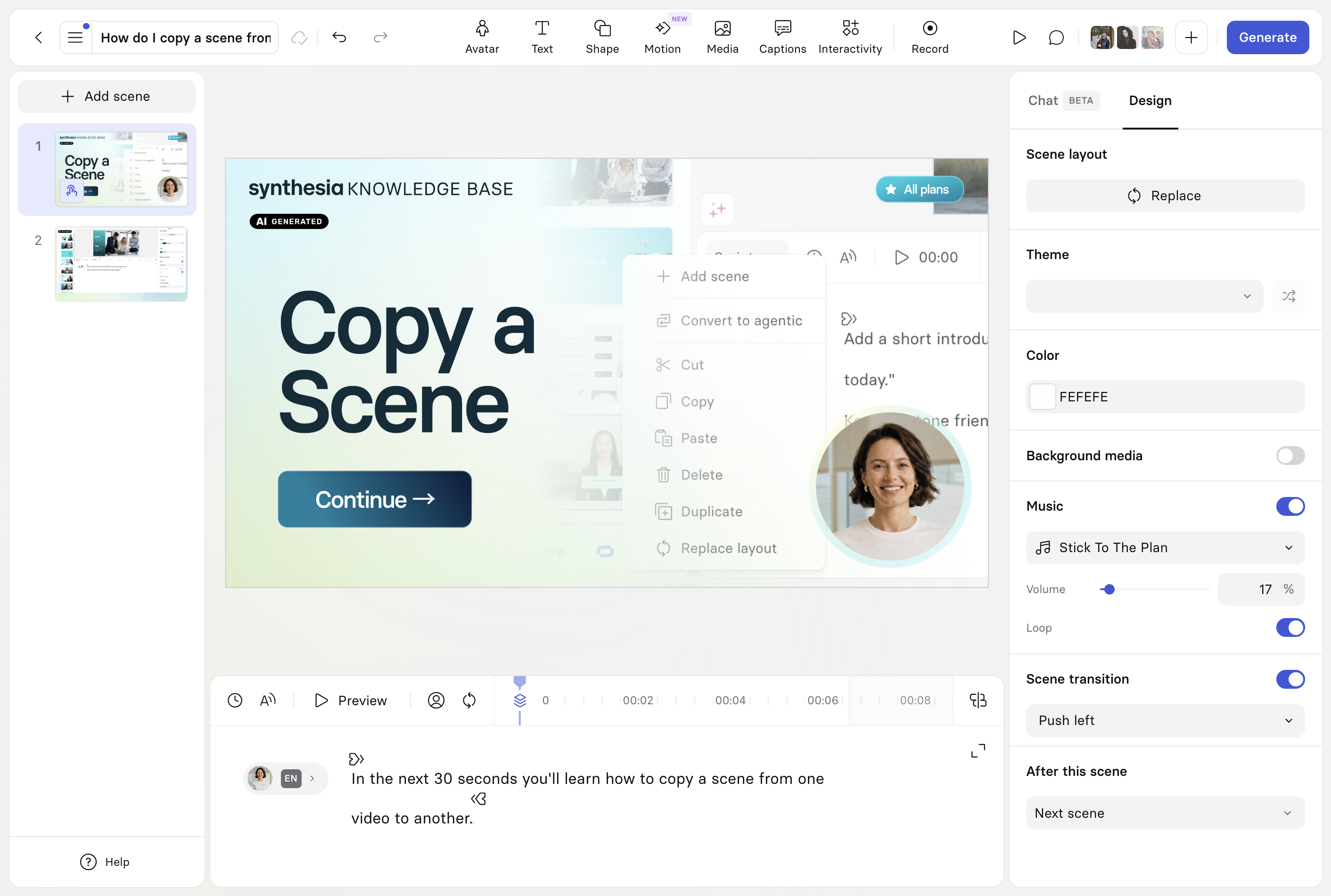
There are 5 main sections of the editor:
- The toolbar, at the top: access video-level settings, add elements, collaborate, preview, and generate your video.
- The scene list, on the left: add, reorder, and navigate between your video's scenes.
- The canvas, in the center: design the visuals for the scene you're currently working on.
- The inspector panel, on the right: adjust settings for the current scene, or for whatever element you have selected.
- The script box, at the bottom: write and edit your script, and set the avatar, language, and voice speaking it.
Toolbar

The toolbar is where you can go to access the video actions menu, set a title for your video, undo and redo actions, add elements to the canvas, add comments and collaborate with invited users, preview a draft of your video, and generate your video.
Video actions menu
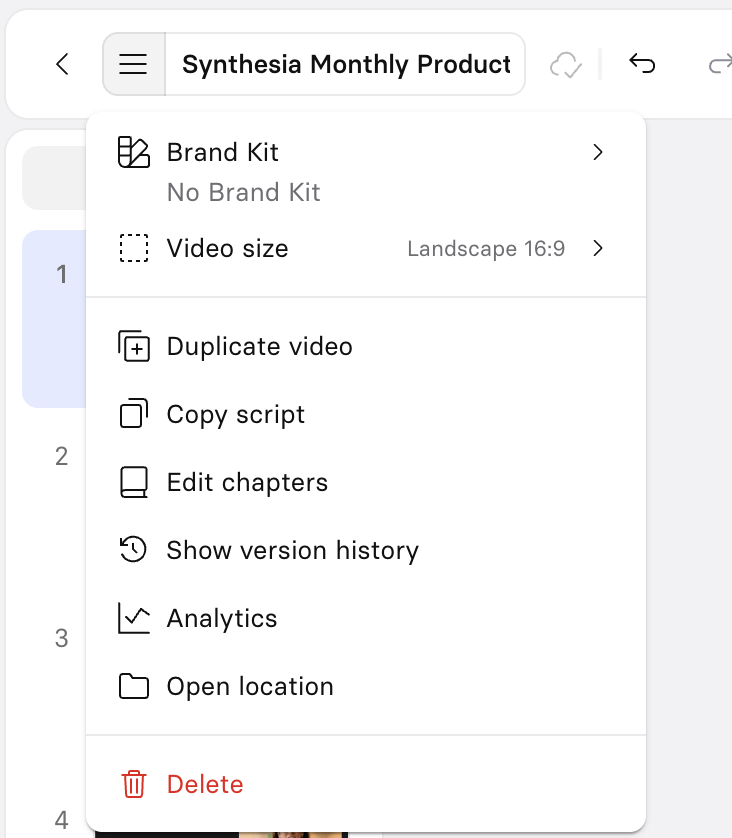
Select the hamburger icon next to the video title to adjust the following video settings:
- Brand kit: The brand kit to apply.
- Video size: The video's aspect ratio.
- Duplicate video: Duplicate the current video into your My videos section.
- Copy Script: Copy the entire video script in markdown format.
- Edit chapters: Define and edit your video chapters.
- Show version history: Shows the video versions available.
- Analytics: Displays the video analytics for this video.
- Open location: Navigate to the folder containing the video.
- Delete: Delete your video. Once deleted, your video goes into the Trash section.
Video size
Create your video in one of several aspect ratios—we recommend selecting an aspect ratio before designing your scenes:
| Name | Ratio | Width (px) | Height (px) |
|---|---|---|---|
| Landscape | 16:9 | 1920 | 1080 |
| Portrait | 9:16 | 1080 | 1920 |
| Square | 1:1 | 1080 | 1080 |
| Tall | 4:5 | 1080 | 1350 |
| Wide | 5:4 | 1350 | 1080 |
Version history
Every 30 minutes, a snapshot version of your video is auto-saved. A snapshot version is also saved each time you generate a given video.
Restoring and duplicating snapshots
To restore (or duplicate) a given snapshot of your video:
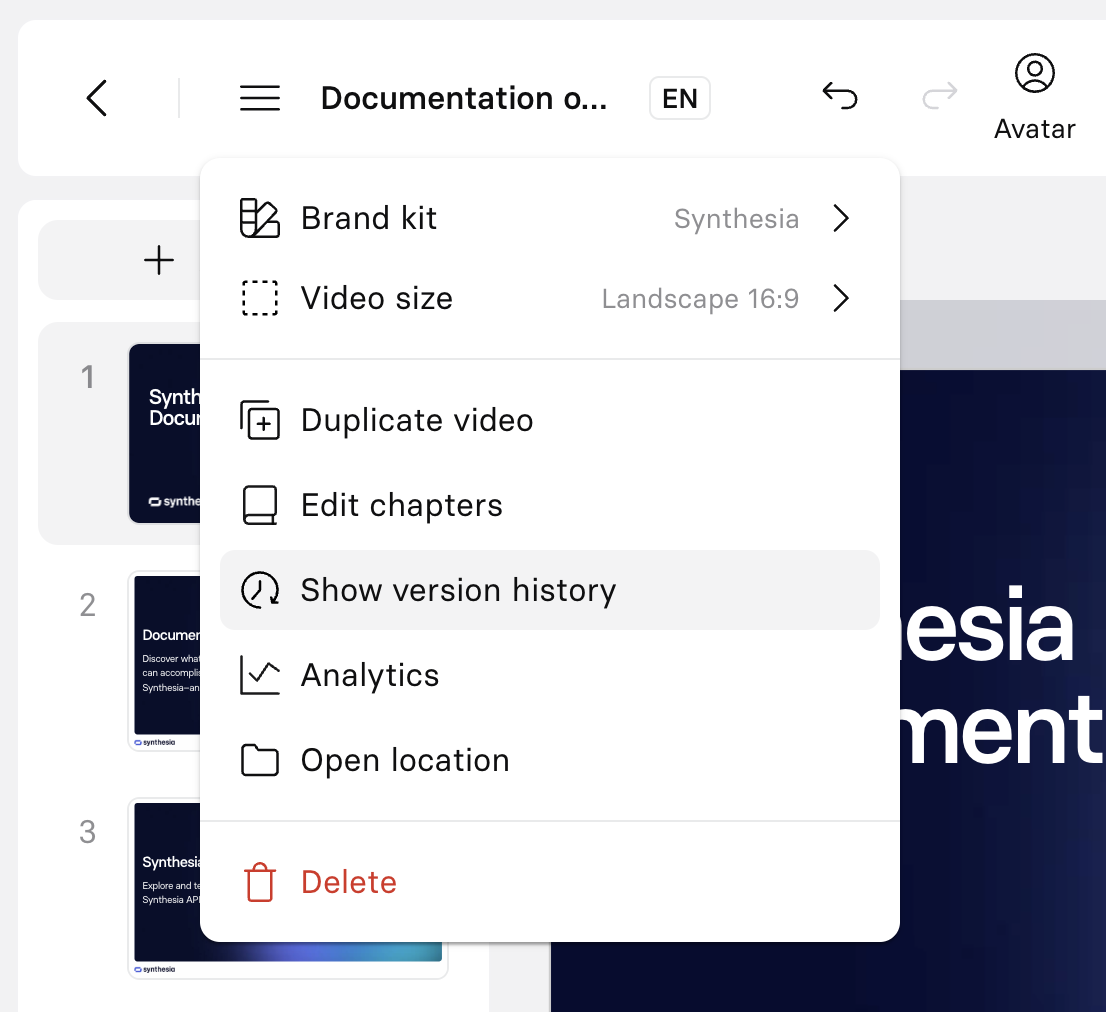
- Select the hamburger menu icon at the left of the toolbar to access the Video actions menu.
- Select the
Show version historyoption. - Access the Version history list on the right side of the editor.
- Select the version you wish to restore or duplicate from.
- To restore this specific version:
-
Hover over the version and select the three-dot menu icon next to the version name.
-
Select the
Restoreoption from the context menu: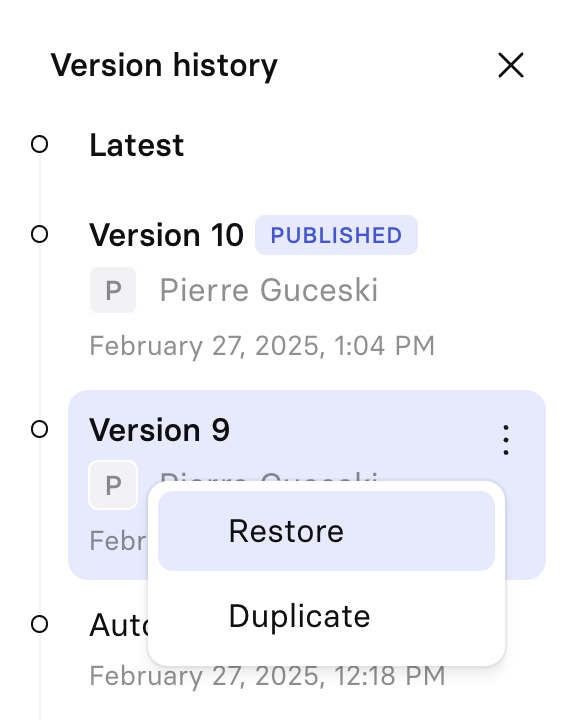
-
Select
Restorein the upper left corner of the page.
-
- To duplicate this specific version:
-
Hover over the version and select the three-dot menu icon next to the version name.
-
Select the
Duplicateoption from the context menu to duplicate the video into the same location it the original resides in: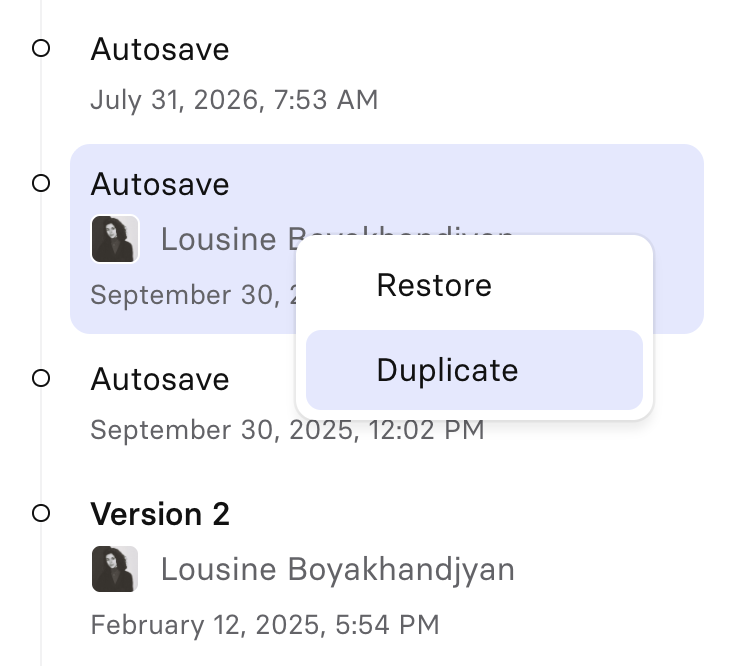
-
Note:While the Version history includes which collaborators were editing a video at the time a given snapshot was auto-saved, or the collaborator who generated the video, granular information about who made which specific edits is not logged.
Elements
In the center of the toolbar is a selection of different types of elements you can add to the canvas for the scene you're currently in.
Comment mode
Select the Comment button or use a keyboard shortcut to enter or exit comment mode.
| Enter/exit comment mode (Mac) | Enter/exit comment mode (PC) |
|---|---|
⌥ + c | Ctrl + c |
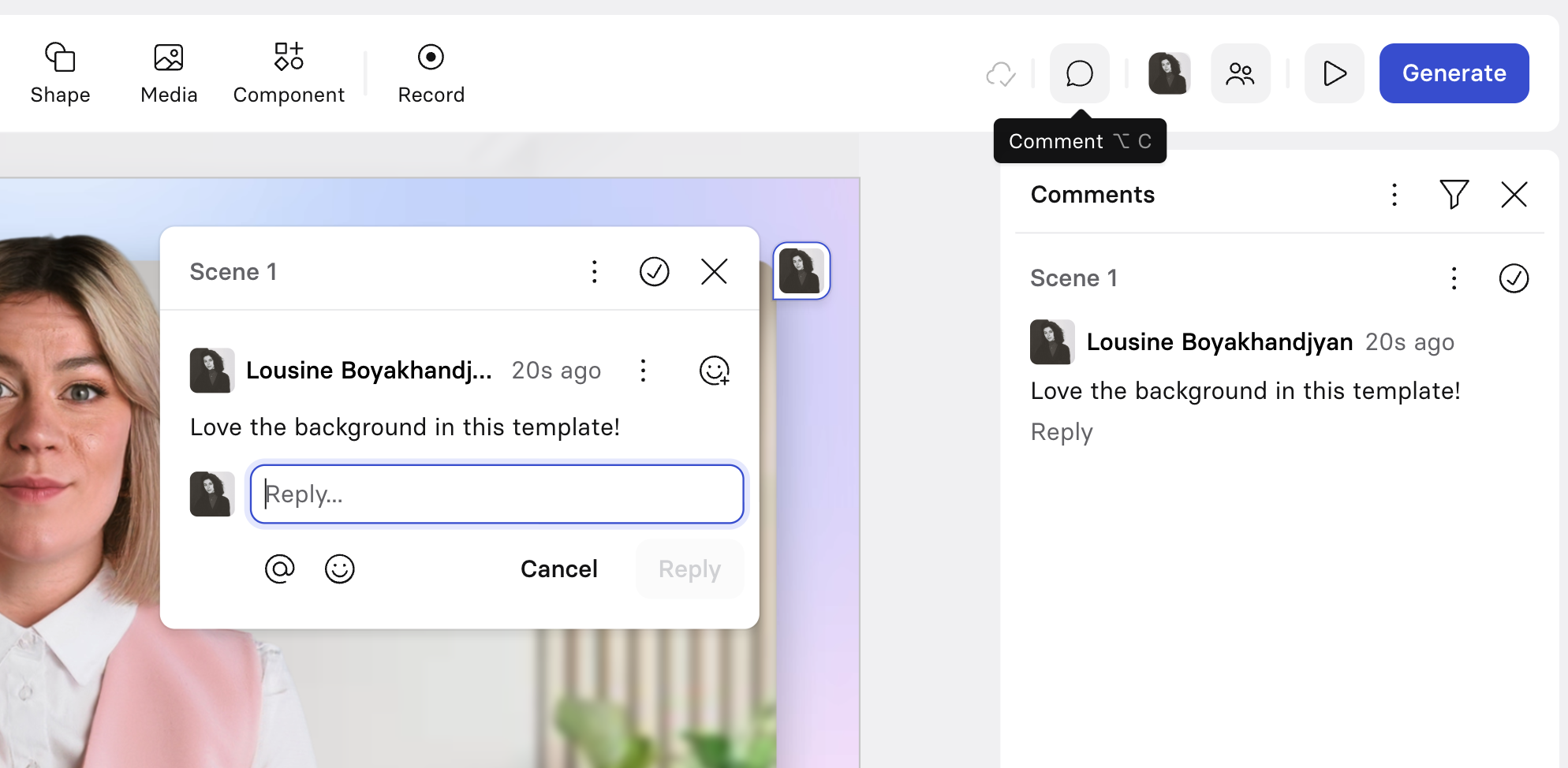
In comment mode, you can navigate to different scenes and add comments by selecting on the canvas.
You can reply, @mention other collaborators, react with emojis, and resolve comments. Select the 3-dot icon to copy a link to the comment, edit your comment, or delete it.
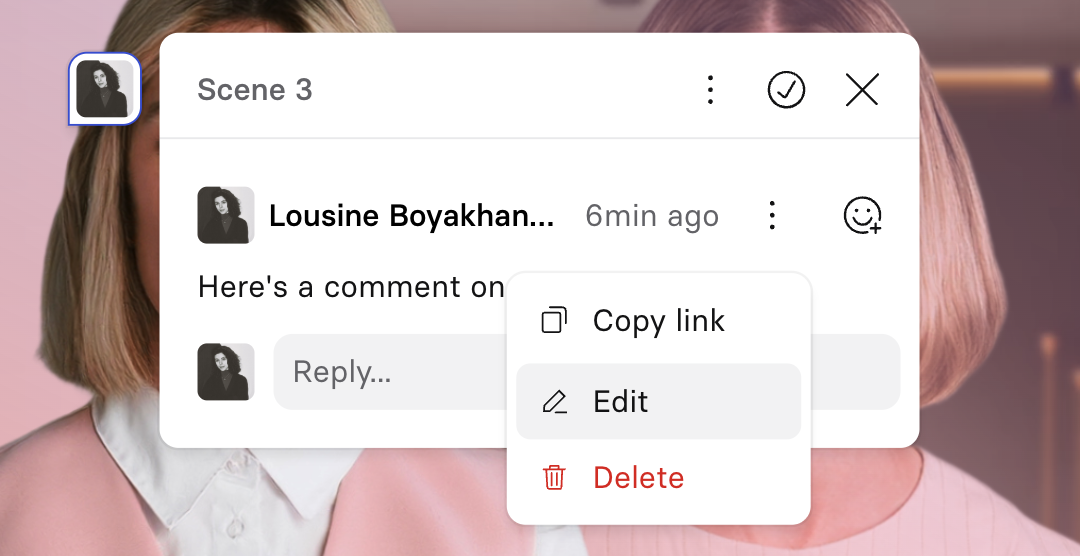
You also have the option to move a comment to a different part of the canvas by dragging it to the desired location.
Comment panel
Comments on each scene are visible on the left in the comment panel.
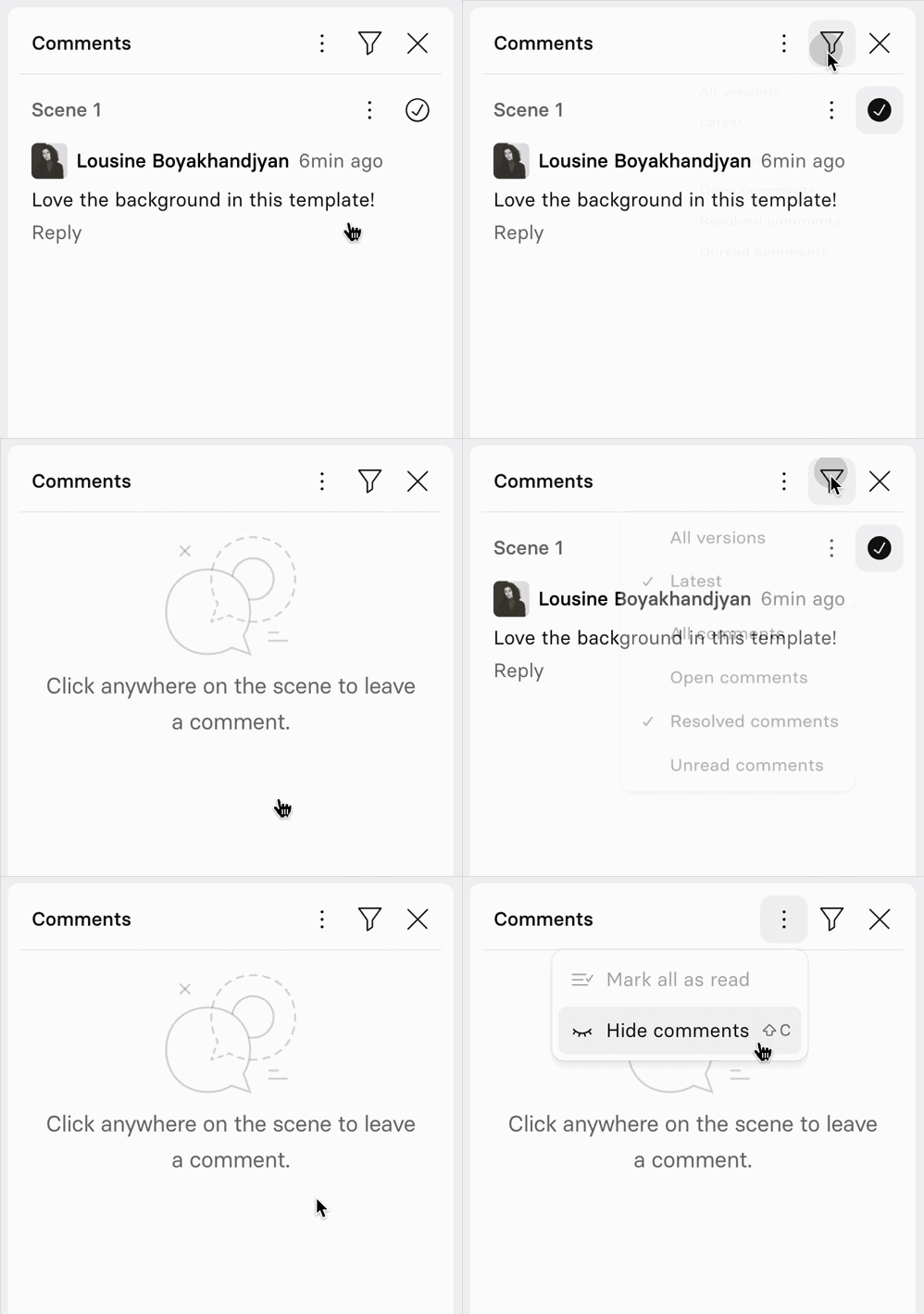
From the comment panel:
- Select the 3-dot icon and either mark all comments as read or exit comment mode.
- Select the filter icon and choose to see comments from all versions of the video, the latest version, or filter by comment status.
- Select the ✕ to exit comment mode or use the keyboard shortcut.
Collaborate
Select the + button to share the current video with another Synthesia user. The shared video appears in their Shared with me page. If they are not already a member of your workspace, and guest invites are enabled, you can invite a guest to review and comment on the video:
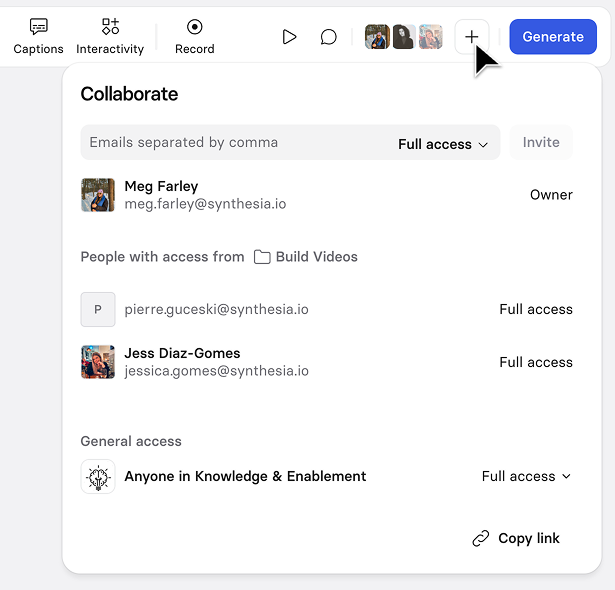
Add the email of someone you'd like to collaborate with and choose one of the following levels of access:
- Full access: Can comment, edit, and share the video.
- Can edit: Can comment and edit the video, but can't share it.
- Can comment: Can comment, but can't edit or share the video.
You can also adjust your General access settings to apply any of the above levels to everyone in your workspace at once.
See Collaboration for the full breakdown, including how guest invites and folder-level access affect what someone can do here.
Preview video

Select the play button in the upper right corner of the page to launch a preview of the entire video. Always launch a preview before generating a video, to verify that everything is in order and test any interactive elements or avatars you have in the video.
Generate
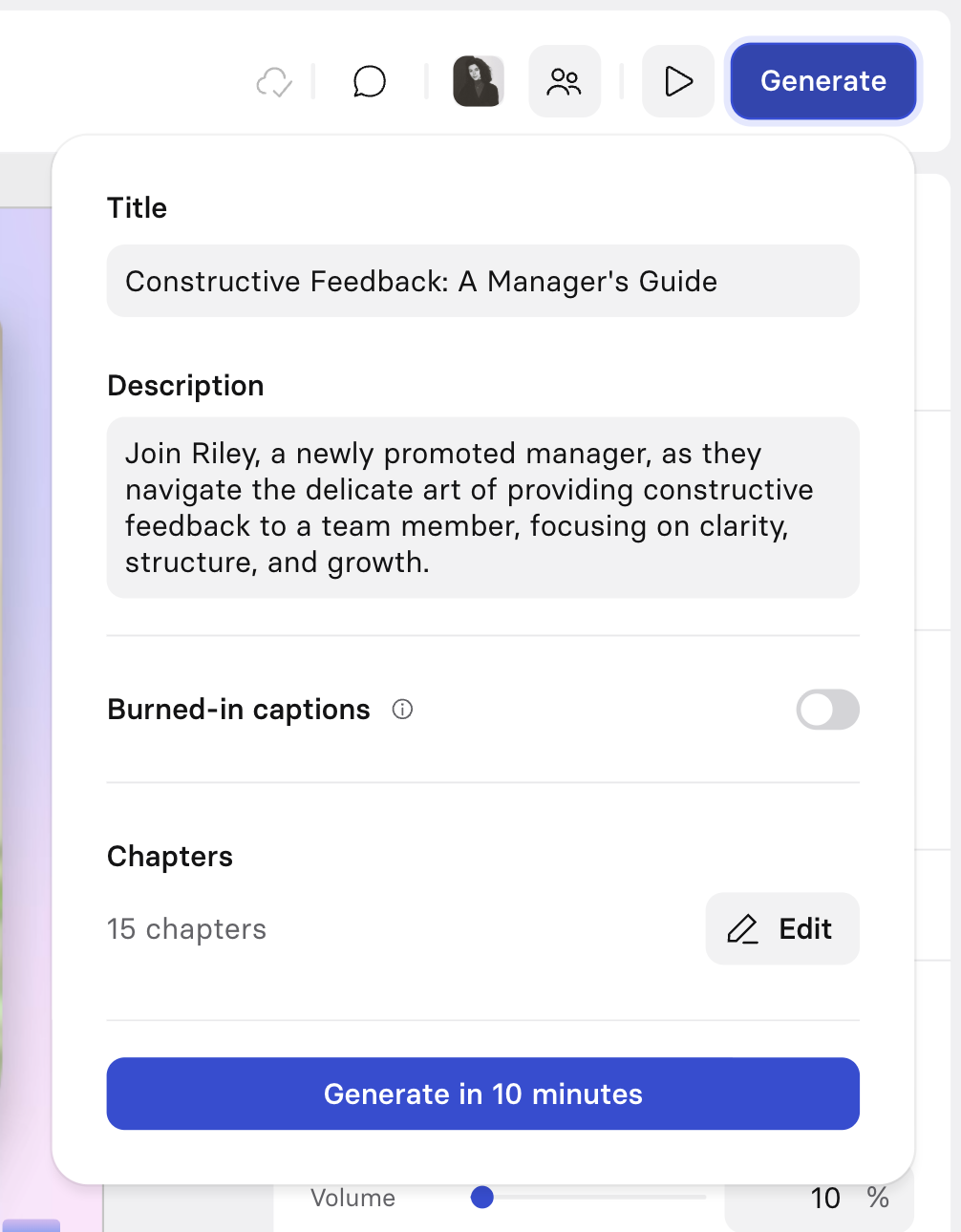
To generate your video, select the Generate button at the right of the toolbar. This opens the generate panel, where you can adjust the following:
- Title: The video title displayed in your Synthesia account and on the share page.
- Description: The video description displayed on the share page.
- Burned-in captions: Toggle whether burned-in captions should be included in the generated video.
- Chapters: The different chapters for your video.
Video captions
Your video's captions depend on the script you've added to your scenes. There are three types:
- Dynamic captions: Fully customizable captions (font, color, size, position) that inherit from your brand kit. Viewers can toggle these on or off when watching via Synthesia's video player.
- Closed captions: Standard captions that viewers can toggle on or off, without the same styling control as Dynamic Captions.
- Burned-in captions: Permanently embedded into the video frame, and can't be toggled off by viewers.
See Captions for the full breakdown of Dynamic Captions, including brand kit inheritance and styling options.
Burned-in captions are most useful if you're downloading your video to upload to another platform that doesn't support uploading a separate subtitle file. You can download subtitle files for your video in .srt and .vtt formats from the video overview page.
Issues
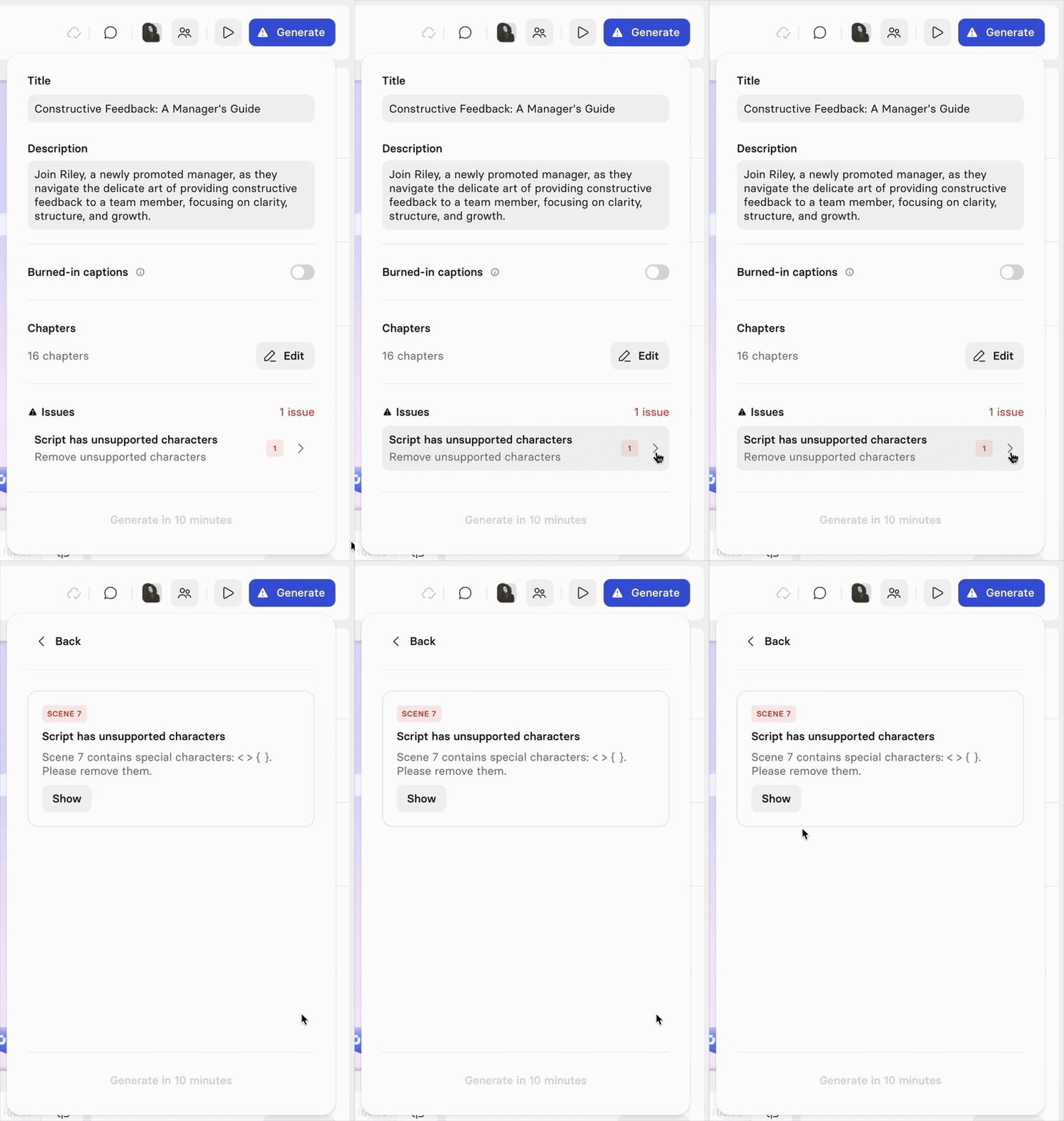
If there are any issues preventing generation of your video, like unsupported characters in the script, moderation issues, or lack of permissions for an avatar or voice, you'll be notified in the issues section.
You'll be shown a list of issues you can select, then navigate directly to the scene with the issue so you can fix it and generate your video:
Scene list
A Synthesia video is composed of multiple scenes in a row, linked by scene transitions.
Note:The maximum amount of scenes per video is 150 scenes, each up to 5 minutes long—in total, a Synthesia video can be up to 4 hours long.
New scene
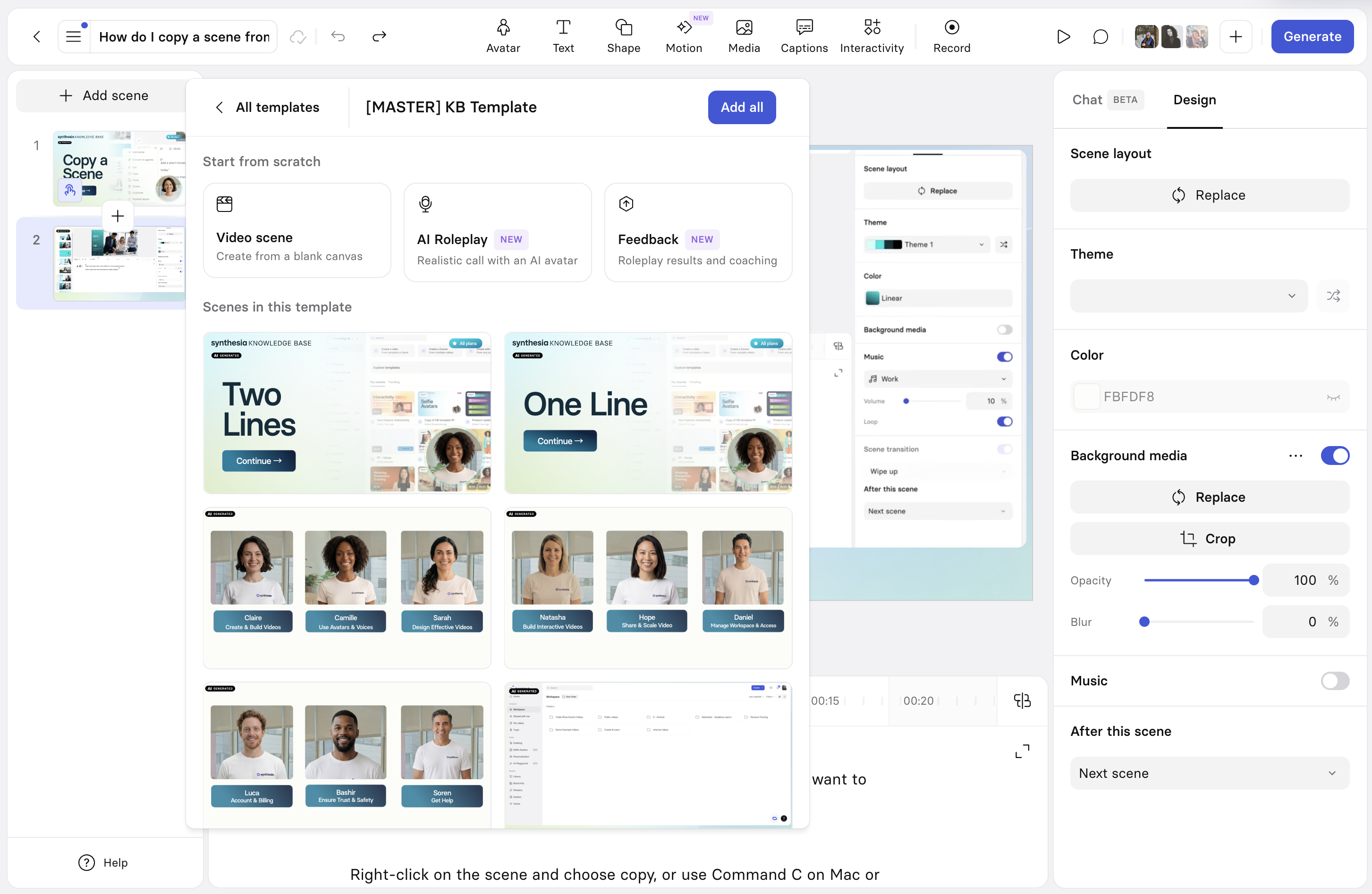
Select + Add scene at the top of the scene list to add a new scene after the one you have currently selected, or the + button after any scene to add a new scene after that specific scene (appears on hover).
You'll have the option to add a layout (or all layouts at once) from the current template you're working from, or go back to select a template from Synthesia's stock template library or one of your custom templates, so you can mix and match. See Templates for more on browsing and building templates.
Managing scenes
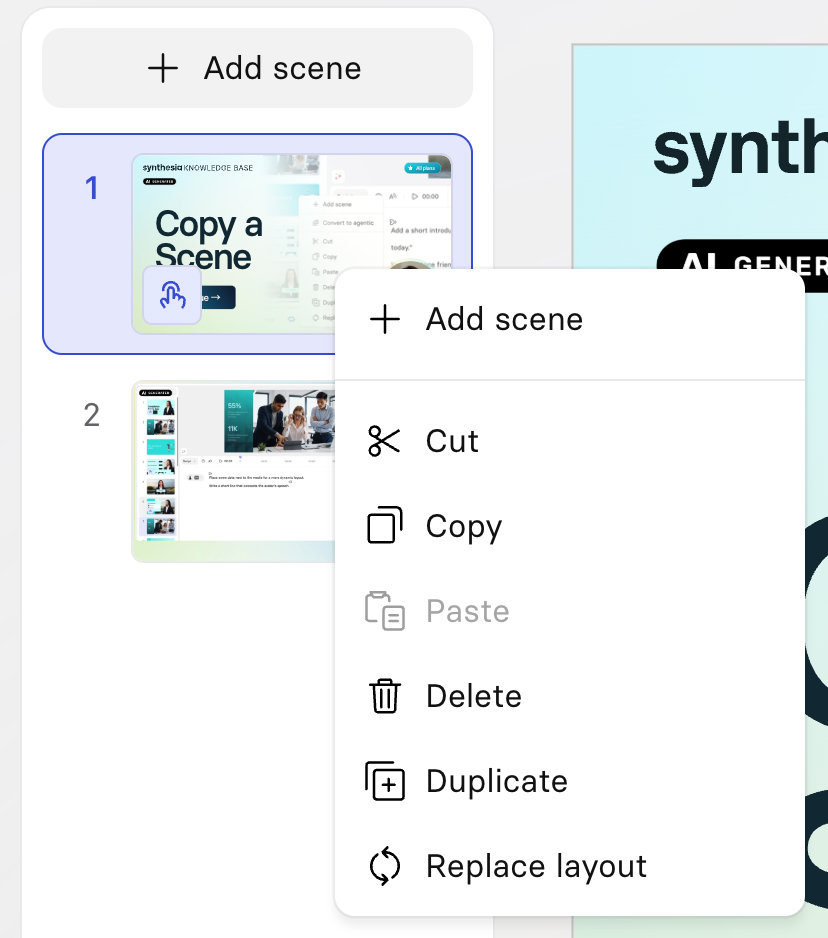
Right-click a scene in the scene list for more options:
Add scene: Add a new scene after this one.CutCopyPaste: Only available if you've cut or copied a scene first.DeleteDuplicateReplace layout
Selecting scenes
You can select a single scene, or select multiple scenes to move, delete, cut, copy, and paste them together. Scene selection works like standard file selection in most file browsers:
- Select a single scene: Select it.
- Select multiple specific scenes: Select a scene, then
Ctrl/Cmd+ select any other scenes to add them individually, in any order. - Select a range of scenes: Select the first scene, hold
Shift, then select the last scene, to select every scene in between. - Select all scenes: Select any scene, then press
Ctrl/Cmd+A.
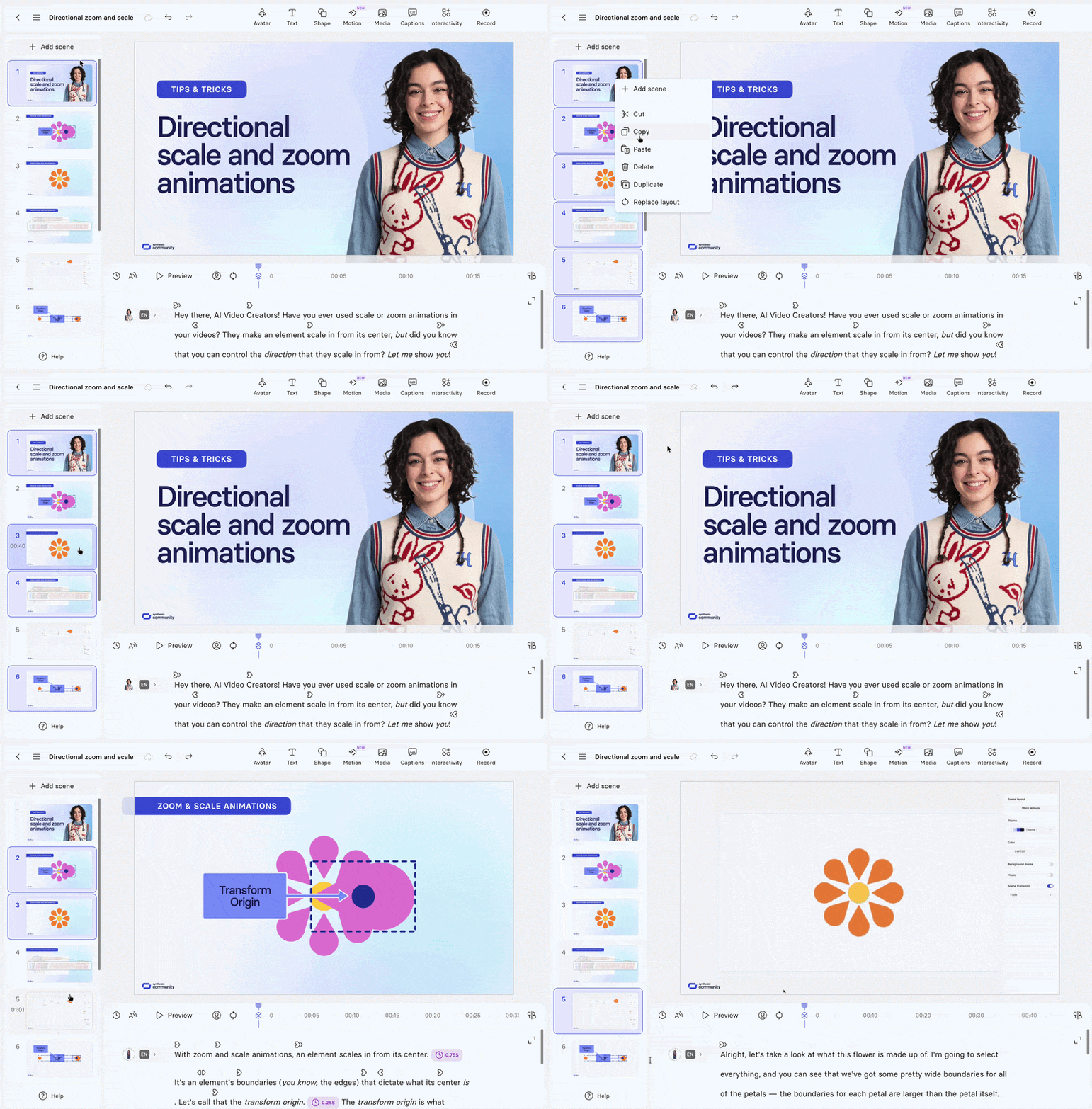
Moving, copying, and pasting scenes
Drag one or more selected scenes to reorder them within the video.
Cut or copy one or more selected scenes, then paste them either later in the same video, or into a different video entirely. Pasted scenes are inserted immediately after your current selection.
To copy one or more elements to multiple scenes in bulk, rather than copying entire scenes, see Copying elements to other scenes.
Note:If you paste scenes into a video in a different workspace that doesn't have access to the avatar or voice used—most commonly a custom avatar—you'll need to replace the avatar and voice in those scenes. If the avatar's owner wants to share it with your workspace instead, they can contact customer support.
Canvas
The canvas is the main, central area of the editor. It's where you design the visuals for each scene. Add elements to the canvas from the toolbar, then animate, edit, and customize them as desired.
Inspector panel
The inspector panel is on the right side of the editor, with two tabs:
- Chat: Use Assistant to iterate on your video conversationally. Available on paid self-serve plans.
- Design: Direct controls for the scene or element you're working on.
On the Design tab:
- If you don't have any element selected, it shows settings for the scene itself.
- If you select an element in the canvas, like an avatar, text element, or shape, the available settings switch to the relevant settings for that element—see the subpages under Elements (Avatar, Text, Shape, and so on) for each element type's specific settings.
Scene settings
With nothing selected on the canvas, the Design tab shows the following, top to bottom.
Scene layout
Select Replace to swap the current scene's layout for a different one from a template, without affecting your script. This will open the template panel with layouts from your current template.
Theme
Select one of your brand kit's color themes to apply to the scene, or select the shuffle icon to cycle through variations.
Color
Set the scene's background color.
- Solid color: Enter a hex value or use the color picker.
- Gradient: Linear or Radial. Add up to 5 color stops—select the gradient bar to add a stop, double-click or drag a stop off the bar to remove it, and drag a stop to reposition it. Each stop has its own color and opacity. For a linear gradient, set the direction using the arrows or a degree value. A radial gradient is always a centered circle—you can't move the centerpoint or make it elliptical. See Shape and Text for the same gradient mechanic applied to those elements.
- Semi-transparent: Lower the color's opacity to blend it with the canvas's default white background.
Background color and background media can be used together. For example, set a background image's opacity to 50% with a light blue background color behind it, and the image takes on a light blue, semi-transparent tint—useful for improving text contrast without losing the image entirely. Background color is completely hidden if background media is set to 100% opacity.
Background media
Toggle Background media on to add an image or video behind everything else in the scene.
- Select
Replaceto choose the image or video. - Background media can't have animations applied to it.
- Right-click any image or video and use the context menu to attach it to the background of the scene, or right-click on existing background media and use the context menu to detach it from the background and use it as a regular media element.
- A video background gets standard video settings:
Crop,Trim, play mode (Once,Stretch, orLoop/Cut), volume, opacity, and blur. - An image background gets standard image settings—see Media for the full set of editing options for images and videos.
Music
Set the tone for your scene and increase audience engagement by adding music.
To add music to a scene:
- Make sure you don't have any elements selected in the canvas (press
Escon your keyboard to deselect anything that's currently selected). - Turn on the Music toggle from the inspector panel on the right.
- Choose from your music asset library or the Soundstripe library. Use the search bar to find specific tracks and preview them. You can filter your music tracks by Genre, Mood, Duration, or Instrumental.
- Select
Addto insert the selected track into your scene. - If desired, select
Changein the pop-up that appears at the bottom of the editor to update all music for your scenes to be the same as the track you just selected.
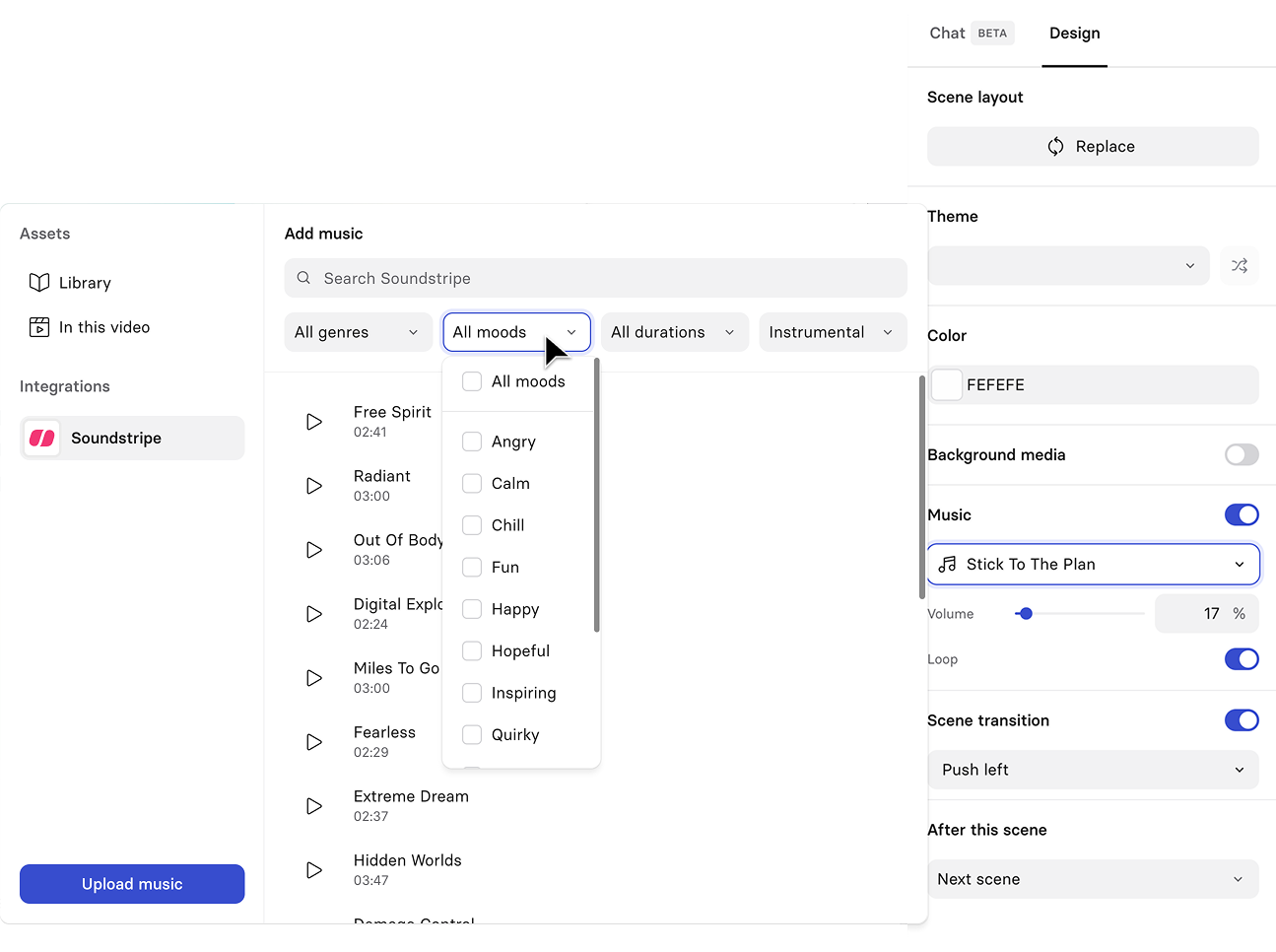
Once music is added:
- Control its volume: The music volume is set to 10% by default. Drag the slider to adjust the volume—you'll have the option to adjust the volume for all the scenes that have that same track applied.
- Loop the music: Decide whether or not to loop the music if the track ends before the scene does.
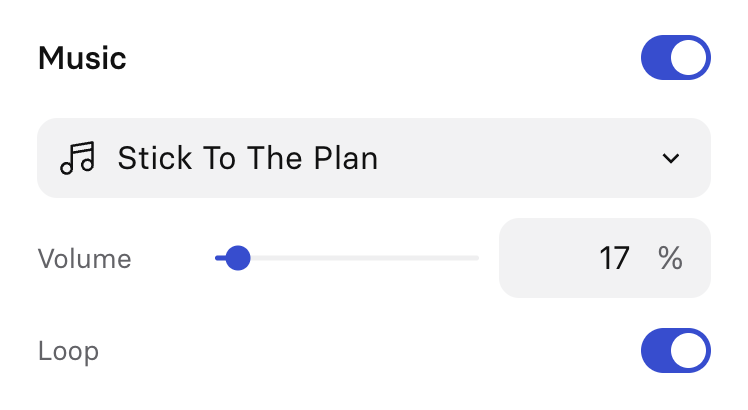
Note:If you've used the same music track for successive scenes, the music plays seamlessly through those scenes.
Important:If you plan to upload a video that includes music from Soundstripe's library to YouTube, don't forget to generate YouTube codes for your video. YouTube codes prove that you had the right to use music from Soundstripe in your video.
Music upload
There are two ways to upload your own music to add to your scenes:
- From the music menu in the editor, by selecting the
Upload musicbutton. - From the Library page.
Supported formats: .mp3, .wav, .ogg, .aac, and .flac.
Scene transitions
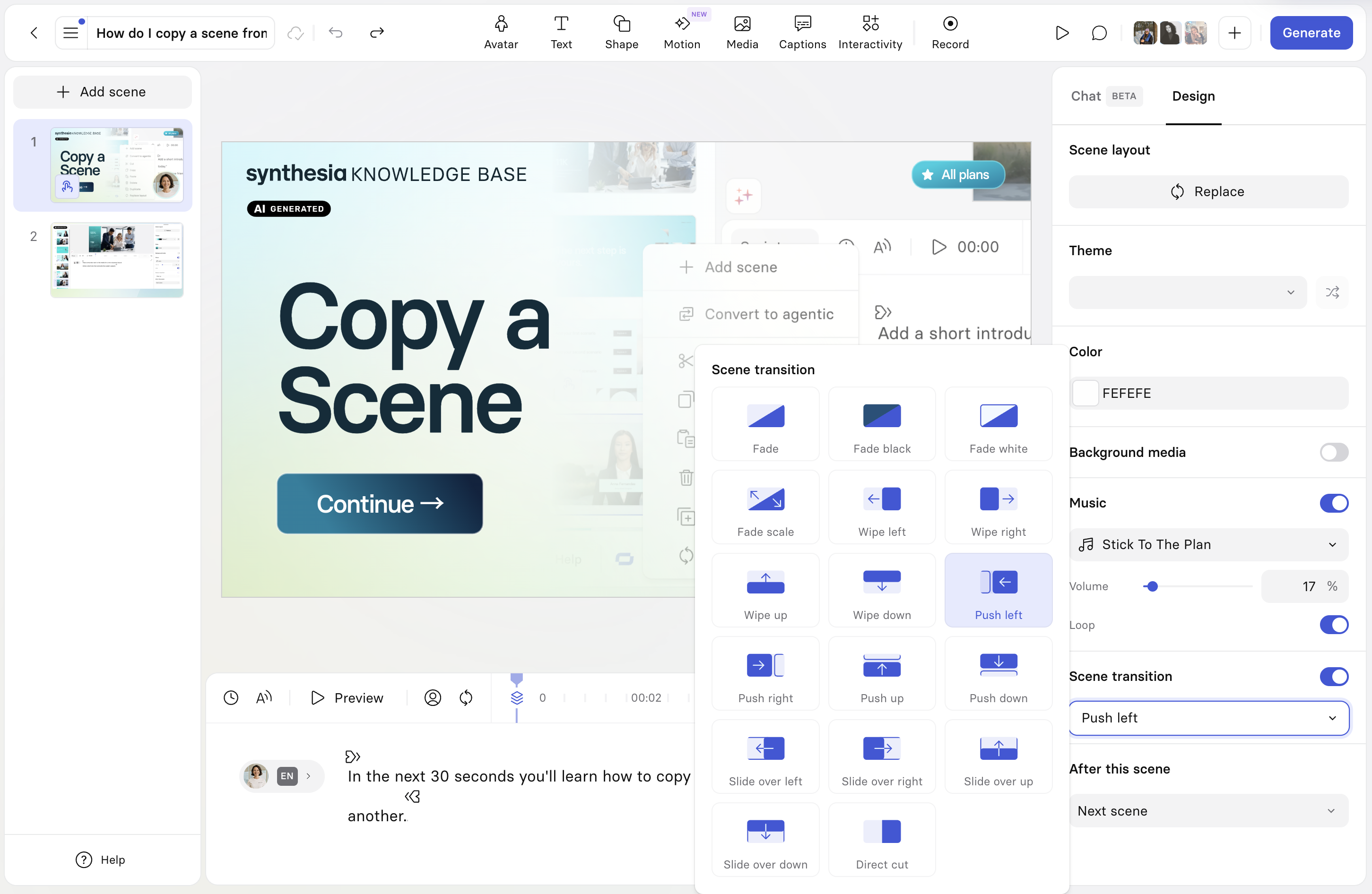
To add a transition:
- Make sure you don't have any elements selected in the canvas (press
Escon your keyboard to deselect anything that's currently selected). - From the inspector panel on the right, toggle the scene transition setting on.
- Select the desired transition.
- If desired, select
Change allin the pop-up that appears at the bottom of the editor to update all transitions for your scenes to be the same as the transition you just selected.
Note:Scenes with interactive elements can't have scene transitions.
List of scene transitions
Here's a comprehensive list of all possible scene transitions available when creating a video in Synthesia:
| Transition | Effect |
|---|---|
| Fade | Gradually fades out the current scene and fades in the next one. |
| Fade black | Gradually fades out the current scene and fades to black. |
| Fade white | Gradually fades out the current scene and fades to white. |
| Fade scale | Gradually fades out the current scene and fades and scales to the next scene. |
| Wipe left | The new scene wipes over to replace the previous scene from the right. |
| Wipe right | The new scene wipes over to replace the previous scene from the left. |
| Push left | The new scene pushes the previous scene to the left to replace it. |
| Push right | The new scene pushes the previous scene to the right to replace it. |
| Push up | The new scene pushes the previous scene up to replace it. |
| Push down | The new scene pushes the previous scene down to replace it. |
| Slide over left | Slides the new scene in from the right, slightly overlapping the previous scene. |
| Slide over right | Slides the new scene in from the left, slightly overlapping the previous scene. |
| Slide over up | Slides the new scene in from the bottom, slightly overlapping the previous scene. |
| Slide over down | Slides the new scene in from the top, slightly overlapping the previous scene. |
| Direct cut | A straightforward, immediate switch from one scene to the next. |
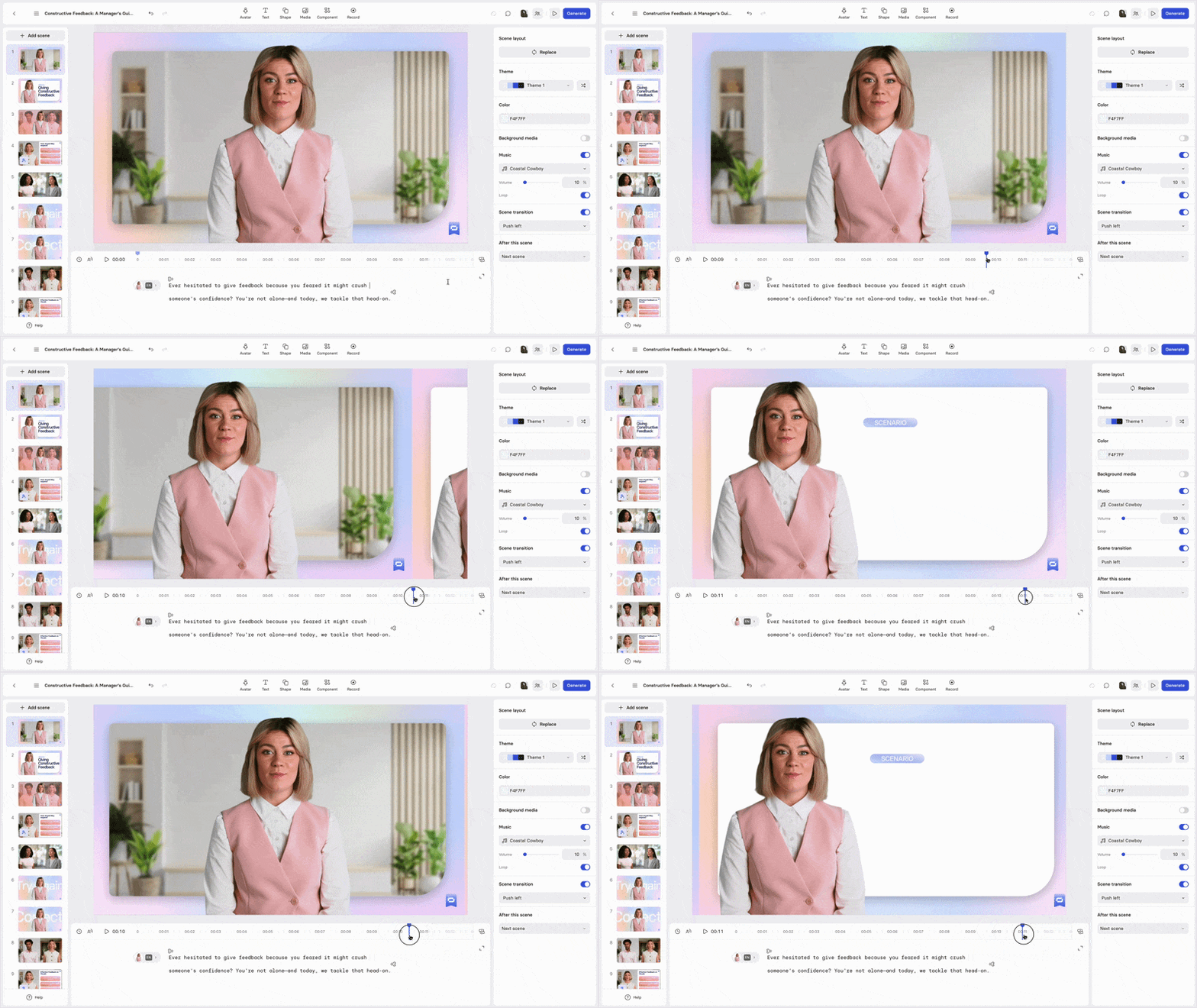
Previewing scene transitions
You can preview any of these scene transitions by dragging the playhead at the top of the script box to the very end of the timeline:
After this scene
Set what happens once the current scene finishes:
Next scene: Direct the viewer to the next scene in the video.End video: Set the current scene as the final scene of the video.- A specific scene, listed by its position (
Scene 1,Scene 2, and so on).
See Interactivity for how to use this setting, together with buttons, to build branching videos.
Script box
The script controls what is happening in your scene, use it to set the avatar that is speaking, its language and voice. Use triggers to trigger animations for elements based on the words in your script.
See the Script documentation to learn more.
Updated about 2 months ago