

User licenses
Manage Synthesia user licenses
Synthesia has three license types. They determine whether a seat is paid, and which actions the associated user can take.
- Full license: a paid license. Users can take all actions available to their role and permission level.
- Free license: an unpaid license, upgradeable to Full. Users can take most actions immediately; some auto-upgrade the license to Full when performed. A Free license can only be assigned when a user first joins—for example, as the default license type. Once changed to Restricted or Full, a license can't be reassigned back to Free.
- Restricted license: an unpaid license, not upgradeable by the user themselves. Users can take a limited set of actions.
Your license is set per workspace, not across your whole account—if you belong to more than one workspace, you can have a different license in each, for example Full in one and Restricted in another.
Note:Despite the name, a Free license doesn't mean a user can create or edit video content at no cost. Actions like creating, generating, or duplicating a video auto-upgrade a Free license to Full, which is billable.
Free and Restricted are both unpaid—the difference is that Free auto-upgrades when a user takes a gated action, while Restricted requires an admin to approve the upgrade first.
Licenses vs. roles
A license and a role are independent settings—assigning one doesn't determine the other.
- Your license (Full, Free, or Restricted) determines which actions you can take, like creating or editing videos.
- Your role (Admin, Member, or Guest) determines what you can access and manage, like settings, workspace membership, and Brand Kits. See User roles & permissions for the full breakdown.
Note:A Free or Restricted license user can hold an Org admin, Workspace admin, or Brand admin role. This is especially useful for someone who manages settings and users but doesn't create video content themselves—they don't need a paid seat to do it.
License options
What each license can do:
- ✅ = users can perform this action with this license.
- 🆙 = users can perform this action, but doing so auto-upgrades their license to Full.
- 🙋 = users can't perform this action, but can request an upgrade to Full.
Videos
| Actions | Full License | Free License | Restricted License |
|---|---|---|---|
| Create & generate videos | ✅ | 🆙 Auto-upgrade action | 🙋 Request to upgrade |
| Edit video scenes | ✅ | 🆙 Auto-upgrade action | 🙋 Request to upgrade |
| Edit scripts | ✅ | ✅ | ✅ |
| Edit pronunciation | ✅ | ✅ | ✅ |
| Add screen recordings | ✅ | ✅ | ✅ |
| View & comment on videos | ✅ | ✅ | ✅ |
| Share & publish videos | ✅ | ✅ | ✅ |
| Move videos | ✅ | ✅ | ✅ |
| Delete & restore videos | ✅ | ✅ | ✅ |
| Download videos | ✅ | ✅ | ✅ |
| Duplicate videos | ✅ | 🆙 Auto-upgrade action | 🙋 Request to upgrade |
On a video where they have edit or full access permission, Free and Restricted license members (not guests) can:
- Edit the script of existing scenes.
- Set or change pronunciation for a word.
- Add or edit a translation for a term.
- Create a new screen recording and add it as a new scene.
- Preview changes.
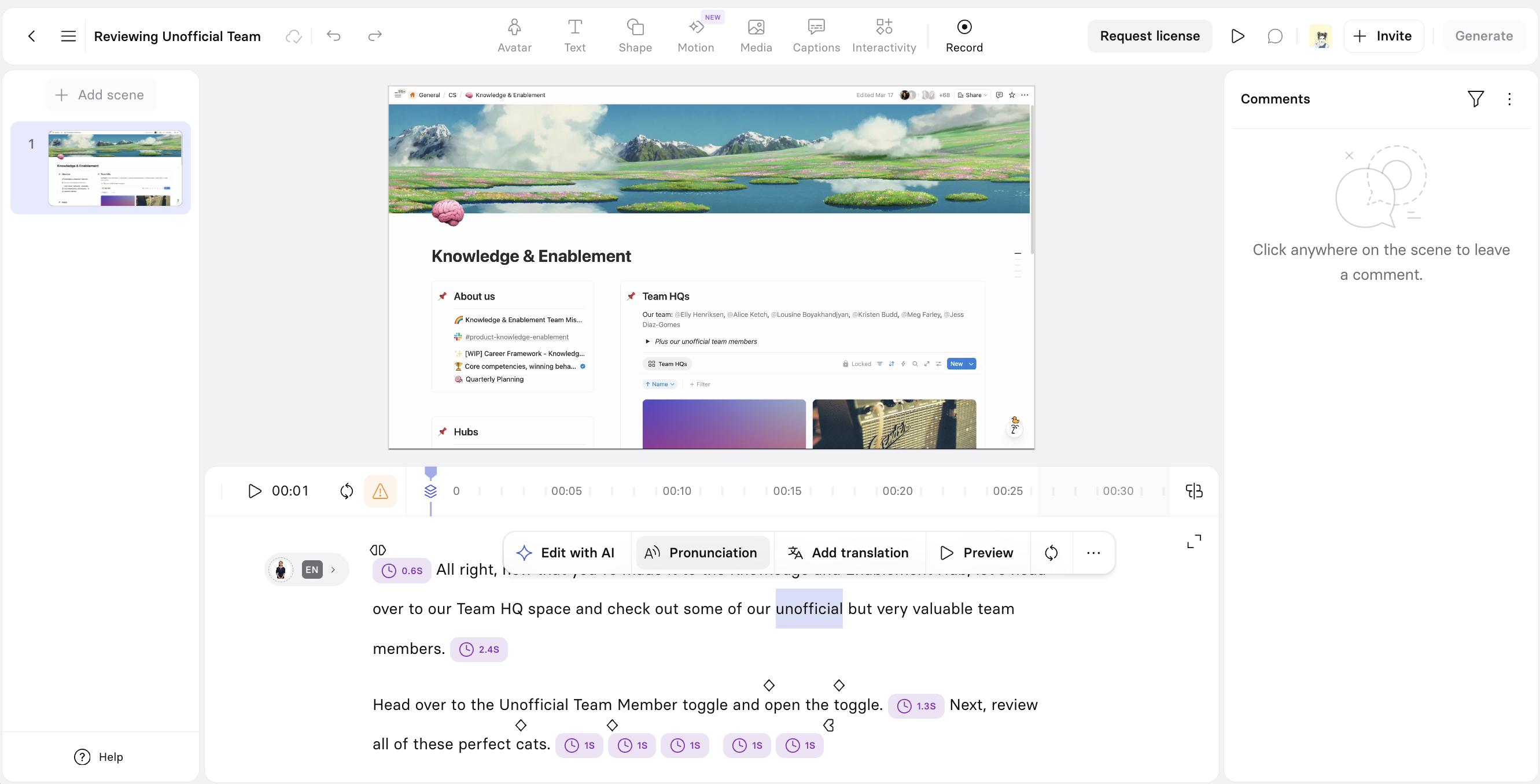
A Restricted member editing the script for a video they have been given full access to.
Pronunciation and translation edits aren't license-gated at all—anyone with edit or full access permission on a video can set either for it, two ways: locally, which only affects that one video, or by saving it to the glossary, which standardizes it workspace-wide for future videos too.
This makes it possible to bring in translation reviewers, internal or external, on a Free or Restricted license without spending a Full seat on them—they can adjust translations and pronunciation directly, and optionally standardize their fixes in the glossary for future videos too.
Saving to the glossary is what Restricted glossary management controls—if it's on, only admins can save to the glossary, though anyone can still make local pronunciation and translation edits in their own video. Your Free and Restricted license members can be added as admins, and thus have control over glossary terms and their pronunciations.
What Free and Restricted license users can't do:
- Create a new scene, other than the screen-recording exception above.
- Edit an existing scene's visual content—they can only comment on it.
- Delete effects or animations, though they can move ones already applied to text they've edited.
- Generate or create a new video independent of the video they're been invited to with Edit or Full access.
With comment-only permission, they can view and comment, but not edit.
See How do I edit a video with a free or restricted license? for more detail. Guests can't edit scripts or add screen recordings, regardless of permission.
Folders
| Actions | Full License | Free License | Restricted License |
|---|---|---|---|
| Create folders | ✅ | ✅ | ✅ |
| Delete & restore folders | ✅ | ✅ | ✅ |
Templates
| Actions | Full License | Free License | Restricted License |
|---|---|---|---|
| Create & edit templates | ✅ | 🆙 Auto-upgrade action | 🙋 Request to upgrade |
| View templates | ✅ | ✅ | ✅ |
| Download templates | ✅ | ✅ | ✅ |
| Delete & restore templates | ✅ | ✅ | ✅ |
Library
| Actions | Full License | Free License | Restricted License |
|---|---|---|---|
| Upload assets | ✅ | ✅ | ✅ |
| Download assets | ✅ | ✅ | ✅ |
| Delete assets | ✅ | ✅ | ✅ |
Brand Kits
| Actions | Full License | Free License | Restricted License |
|---|---|---|---|
| Create Brand Kits | ✅ | ✅ | ✅ |
| Edit Brand Kits | ✅ | ✅ | ✅ |
| Delete Brand Kits | ✅ | ✅ | ✅ |
Glossary
Note:Workspace members can edit the glossary if Restricted glossary management is off. If it's on, only admins can edit the glossary.
| Actions | Full License | Free License | Restricted License |
|---|---|---|---|
| Add terms | ✅ | ✅ | ✅ |
| Edit terms | ✅ | ✅ | ✅ |
| Add pronunciation to a term | ✅ | ✅ | ✅ |
| Add translation to a term | ✅ | ✅ | ✅ |
| Delete terms | ✅ | ✅ | ✅ |
| Import terms | ✅ | ✅ | ✅ |
| Export terms | ✅ | ✅ | ✅ |
Avatars & Voices
| Actions | Full License | Free License | Restricted License |
|---|---|---|---|
| Create custom avatars | ✅ | ✅ | ✅ |
| Request custom avatars | ✅ | ✅ | ✅ |
| Preview avatars | ✅ | ✅ | ✅ |
| Create voices & voice clones | ✅ | ✅ | ✅ |
Assigning licenses
If your plan doesn't provision a shared workspace, license assignment is automatic. You can see each member or guest's license from the members page in Workspace settings.
If your plan provisions a shared workspace, workspace admins control license assignment. Admins can pre-set the default license for new members (not guests). See Workspace and Organization settings for more on configuring default licenses for new members.
By default:
- Workspace members join on a Free license.
- Guest members join on a Restricted license.
Admins can change a user's license, including their own, from Workspace settings.
Upgrading a license
Free or Restricted licenses can only be upgraded if your plan provisions a shared workspace and allows multiple Full licenses.
Free license
A Free license auto-upgrades to Full as soon as the user takes an 🆙 auto-upgrade action from the tables above. Once upgraded to Full, a user can only be downgraded to Restricted, not back to Free.
A user on a Free license can be added to a video with full access, editor, or commenter permission without needing to upgrade upfront.
Restricted license
A user on a Restricted license can request an upgrade by performing a 🙋 request to upgrade action. This opens an upgrade modal the user can use to send a request to workspace admins, who must approve it to trigger the upgrade to Full.
Downgrading a license
Full and Free license users can both be downgraded to Restricted:
- By a workspace admin, from Workspace settings.
- By an organization admin, from Organization settings.
Updated about 2 months ago