

Organization settings
Manage settings and permissions across your Synthesia organization and the workspaces within it.
Organizations are available on Enterprise plans.Setting one up requires contacting your Synthesia CSM.
An Enterprise account can have a single workspace, or multiple workspaces. Grouping those workspaces under an organization gives an organization admin:
- Global control over workspace settings, from one place.
- Credit allocation across the workspaces in the organization.
The Organization admin role is independent of license tier—a member on a Free or Restricted license can be made an organization admin. This matters for admins who manage settings and users but don't create video content themselves, since they don't need a Full license to do that.
Organization settings take precedence over the equivalent workspace setting.If an organization admin disables a feature org-wide, or enables it only for an allowlist of specific workspaces, a workspace admin can't turn it on for a workspace that isn't on that list.
General
Set the organization's name from the General section of organization settings.
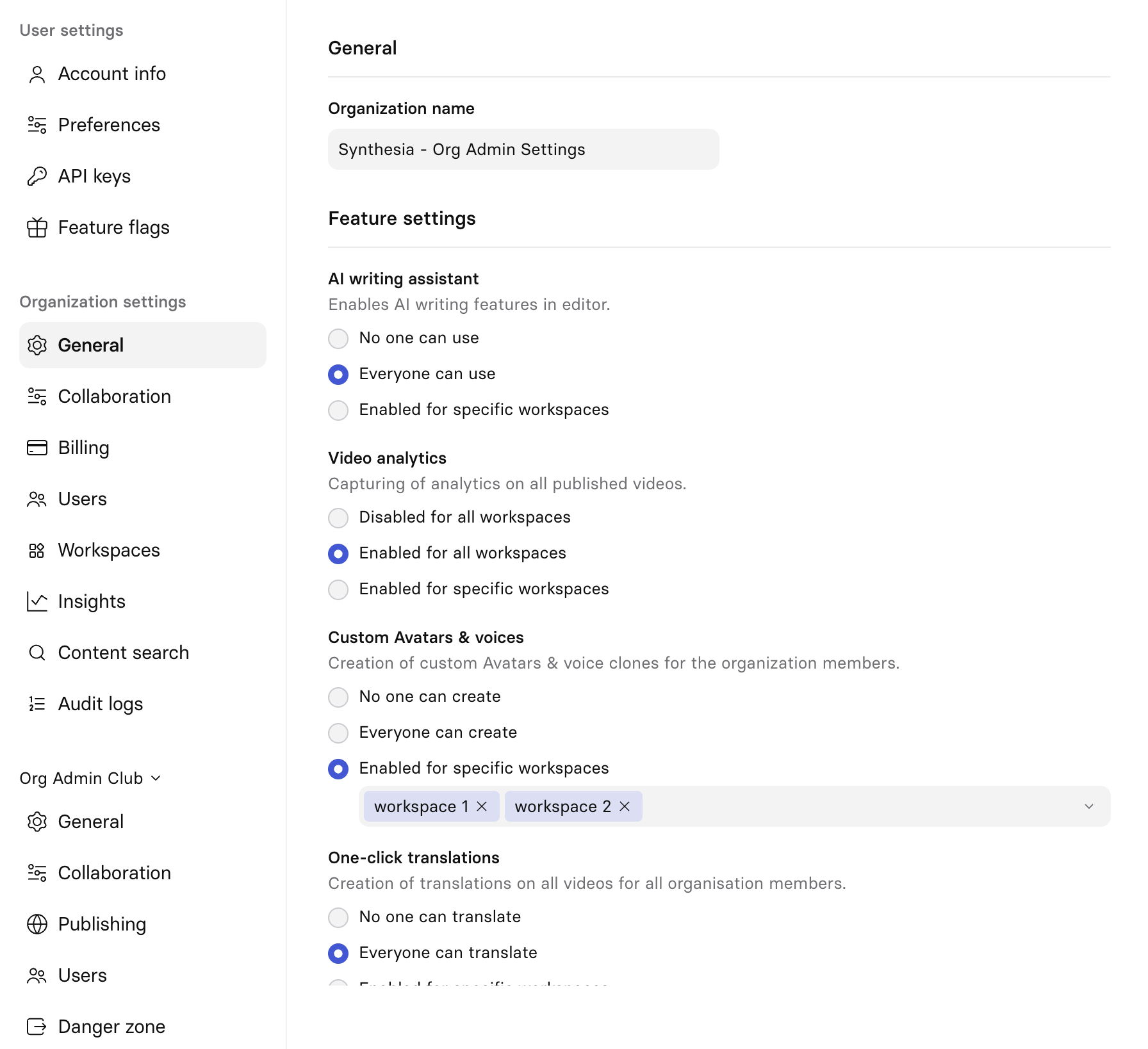
Feature settings
For most features below, choose whether no one in the organization can use it, everyone can, or only specific workspaces can. Defaults apply org-wide unless noted otherwise.
| Feature | Description | Default |
|---|---|---|
| AI writing assistant | Enables AI writing features in the editor. | On |
| Video analytics | Capturing of analytics on all published videos. | On |
| Custom Avatars & voices | Creation of custom avatars and voice clones for organization members. (Options: No one can create / Everyone can create / Enabled for specific workspaces.) | On |
| Avatar Builder | Enables creation of custom synthetic Avatars for organization members. (Options: No one can create / Everyone can create / Enabled for specific workspaces.) | On |
| One-click translations | Creation of translations on all videos for all organization members. (Options: No one can translate / Everyone can translate / Enabled for specific workspaces.) | On |
| AI screen recorder | Requires a browser extension to add screen recordings. | On |
| Upload screen recording | Allows uploading .mp4 screen recordings for AI transcription. | On |
| Dubbing | Enables AI Dubbing. | On |
| AI Translation Engine | Enables the AI translation engine. | On |
| Restricted glossary management | Controls who can manage the glossary, and works differently from the features above. (Options: All members / Admins only / Restrict for admins in specific workspaces.) | All members |
| Personal Avatar requests | Allows users to request a personal avatar from a non-user. (Options: No one can request / Anyone can request / Enabled for specific workspaces.) | On |
| Bulk personalization | Allows creating personalized videos in bulk from a spreadsheet upload. | On |
| Motion graphics | Enables creating motion graphics. | On |
| AI-generated stock content | Enables creating AI-generated stock content, with models managed via settings. | On |
| Script remediation guidance | Shows guidance to help fix script issues before generating a video. (Options: No one can translate / Everyone can translate / Enabled for specific workspaces.) | Off |
| Surveys | Enables Survey feature. | On |
| Roleplays | Shows the Roleplays tab in the left-hand navigation menu, so members can practice conversations with an avatar. | On |
| Aggregated results mode | Hides individual learner results from managers and admins across roleplay analytics. | Off |
Usage fairness
Set a monthly credit limit per user across your organization. When a user consumes more credits than the limit, they're blocked from generating in all of the organization's workspaces until the limit resets.
| Setting | Description | Default |
|---|---|---|
| Limit credits per user | Blocks a user from generating once they've consumed more credits than the monthly limit. | Off |
| Monthly credit limit per user | The number of credits each user can consume per month. The limit applies once you enter a number. | Empty |
The limit resets monthly, on the date your subscription started. A blocked user sees the message You've reached your monthly credit limit with the reset date.
To see how many credits each member consumes, export the per-member report from Insights. To allocate credits across workspaces, see Billing & Usage.
The limit is one number for the whole plan. It applies to every user and to every product that uses credits, across all workspaces. It doesn't support per-user or per-workspace overrides, and blocked users can't request more credits.
Delete your organization
Contact the Synthesia support team to request organization deletion.
Important:Deleting an organization permanently deletes all of its workspaces and their content for every member, and can't be undone. To export videos before deleting an organization, see the List videos API endpoint.
Collaboration
Workspace discoverability
Allowed domains controls organization discoverability: users on a listed domain can discover workspaces within the organization, unless those workspaces are hidden.
In practice, this is what a user sees when they select Add workspace from the workspace switcher in the top-left corner of the home page: a list of workspaces in the organization they can join.
Invitations
| Setting | Description | Default |
|---|---|---|
| Restrict invitations to allowed domains only | Prevents inviting users outside of allowed domains. Selecting this reveals an Allow guests from non-allowed domains checkbox, to exempt guests from the restriction. | Off |
| Disable guests | Prevents inviting guests from outside the workspace to videos. | Off |
| Disable member invites | Prevents members from inviting new members from outside the workspace. | Off |
| Disable public invite links | Prevents workspace admins from creating or using public invite links. | Off |
Permissions
| Setting | Description | Default |
|---|---|---|
| Disable workspace creation | Prevents members from creating new workspaces within the organization. | Off |
| Disable project publishing | Prevents publishing videos, and unpublishes all currently published videos. | Off |
| Require authentication for published projects | Requires SSO authentication to watch any published video. | Off |
| Disable public project page | Prevents creating a public page for a published video. | Off |
| Brand Kit enforcement | Restricts video styling to your brand kit. | Off |
Important:Disabling video publishing unpublishes every currently published video in the workspace, not just future ones. Re-enabling publishing doesn't restore them—each video needs to be republished manually.
Billing
See Billing & Usage for billing, usage, and credit allocation across the workspaces in your organization.
Users
Lists every member across the organization's workspaces.
Use the search bar, or the filter icon, to narrow the list by user type (All users / Org admins / Guests), license (All licenses / Free / Restricted / Full), or invitation status (show or hide invited users).
Select Add members to invite new members by email. You must specify which workspace each invited user joins.
Set the default license assigned to new users from the Billing tab in settings—see Billing & Usage.
For a given member, you can:
- Select their workspace count to see every workspace they belong to and their role in each (for example, Member or Admin), and to invite them to another workspace.
- Change their user license. Members can join on a Free license, and be upgraded to Full. Once upgraded to Full, a member can only be moved down to Restricted, not back to Free.
- From the three-dot menu: for a member who isn't an organization admin, make them an Org admin or Brand admin, or remove them. Removing a member from the organization disables the API keys they own in every workspace. The remove dialog shows how many keys will be disabled.
- For a member who's already an organization admin, revoke their admin role, change them to Brand admin, or remove them. Remove is sometimes unavailable, depending on the member.
Workspaces
Lists every workspace in the organization, with its member count. Use the search bar to find one, or select Create workspace to add one.
From a workspace's three-dot menu: go to its settings, invite members to it, or delete it.
See Workspace Settings to learn more about workspace-specific settings.
API keys
Select API keys to see every API key in the organization, with its owner, Workspace, status, and expiration date. Filter by owner, status, scope, or inherited keys. An owner marked Removed has left the organization, and their keys are disabled.
For a given key, select the ⋯ menu to:
Disable: stop requests that use the key. You can add an optional reason of up to 200 characters. The owner gets an email with your name and the reason.Enable: reactivate a disabled key. Enable is unavailable while the owner isn't a member of the organization.Delete: permanently remove the key. This can't be undone.
To manage all of one member's keys, go to Users, select the ⋯ menu next to the member, and then select View API keys or Disable all API keys. Disable all API keys covers the member's keys in every workspace.
See How do I manage my members' API keys as an admin? for the full steps, and What happens to API keys when a member is removed? for removals.
Insights
Export a CSV report on how your team uses Synthesia.
- Select a date range: Last 7 days, Last 30 days, Last 90 days, or Specific dates from a calendar picker.
- Select
Get report.
The report takes a few minutes to generate. You'll get an in-app notification and an email once it's ready, and can download the report from either one, attached as a ZIP file containing five CSVs:
| File | One row per | Covers |
|---|---|---|
organization_usage | The organization (single row) | Totals for users, workspaces, pending invitations, license breakdown (Full/Restricted/Free), member/guest/viewer counts, videos created, video versions generated, minutes generated, and credits consumed by category (personalized videos, dubbing, API, and each AI-generated stock content model). |
organization_workspaces_usage | Workspace | The same metrics as organization_usage, broken out per workspace. |
organization_members_activity | Member | Email, license, role, join date, and last activity date, plus that member's own videos created, video versions generated, minutes generated, and credits consumed by category. |
organization_credits_consumption | Credit-consuming event | Timestamp, video title, workspace, product used, minutes generated, and credits consumed—a log rather than a summary. |
organization_generation_credits_by_video | Video using AI-generated stock content | Clips generated and credits consumed, broken down by model (for example, Veo 3, Sora 2, Nano Banana Pro, Flux 2). |
Content search
Search and filter every video and template across the organization's workspaces—including content left behind in a member's My videos (shown as Private), where no one else can otherwise find it.
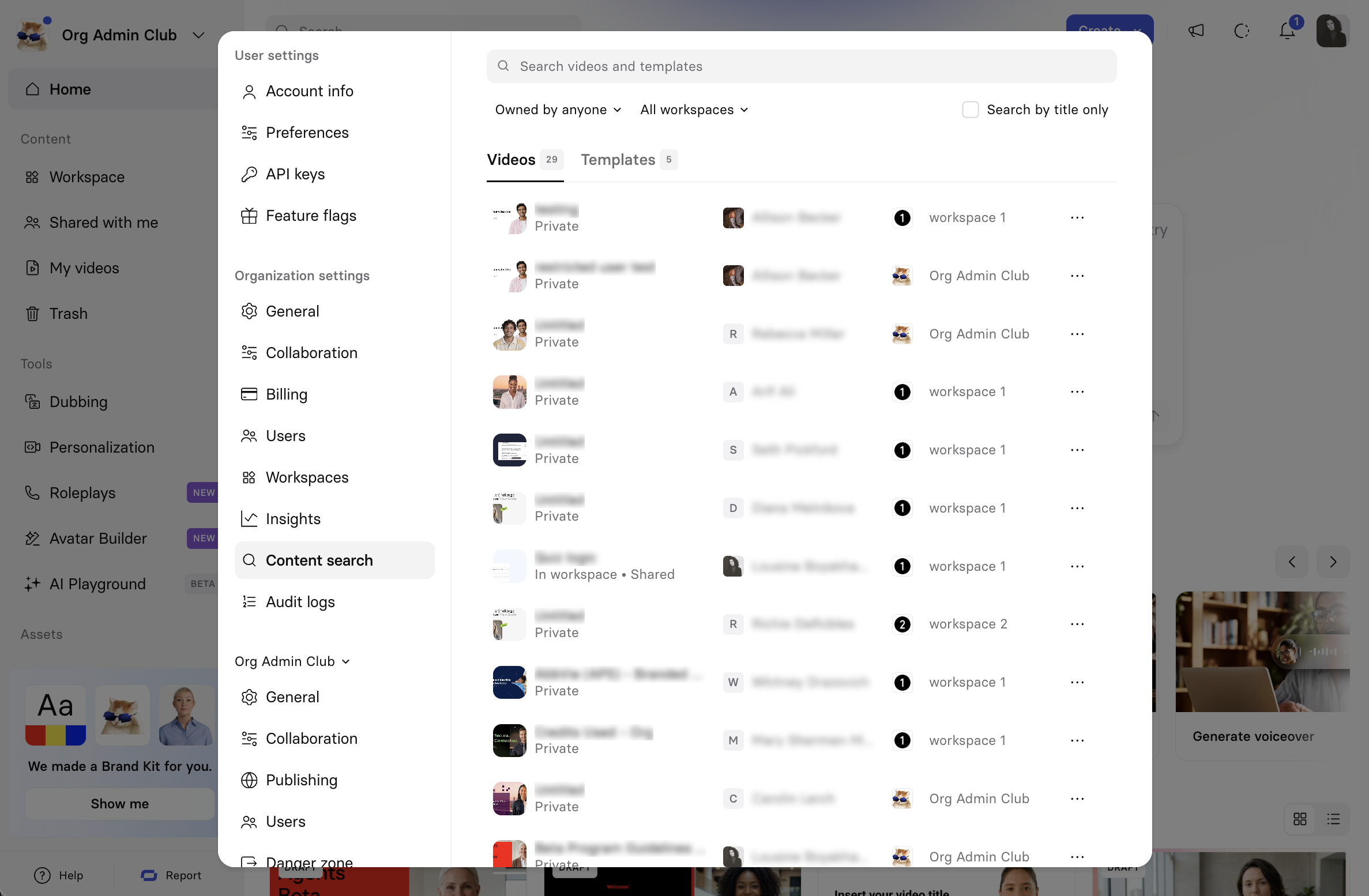
Use the search bar, or filter by:
- Owned by anyone: filter to one or more specific owners, searchable by name or email.
- All workspaces: filter to one or more specific workspaces.
- Search by title only: restrict the search bar to video and template titles.
Results are split into Videos and Templates tabs, each showing the item's owner, workspace, and sharing status (for example, Private, or In workspace and whether it's shared).
- From a video's three-dot menu: Collaborate, Move to, Rename, Download, or Remove.
- From a template's three-dot menu: Copy ID, Set as default (or Remove as default, if it already is one), Download, Rename, Move to, or Remove.
Note:To move a video an organization admin doesn't own—for example, content orphaned in a former employee's My videos (if they haven't been removed as a Synthesia user yet)—select Collaborate to add yourself to it, then open the video and move it into a different folder.
There's no bulk version of this: you need to add yourself as a collaborator to each video individually.
When a member's account is removed
If a member's account is removed while they still own content, their videos move into a folder named Moved videos - [email] in the main workspace. This folder, and everything in it, is owned by the organization's primary admin: its oldest organization admin.
The member's API keys aren't moved to an admin. Synthesia disables them, and workspace admins get an email listing the disabled keys. If a workspace has no admin, organization admins get it.
Audit logs
See Audit logs for a chronological record of user and admin actions across the organization, useful for monitoring usage, investigating anomalies, and demonstrating compliance.
Updated 8 days ago