

Text
Display texts in your scene.
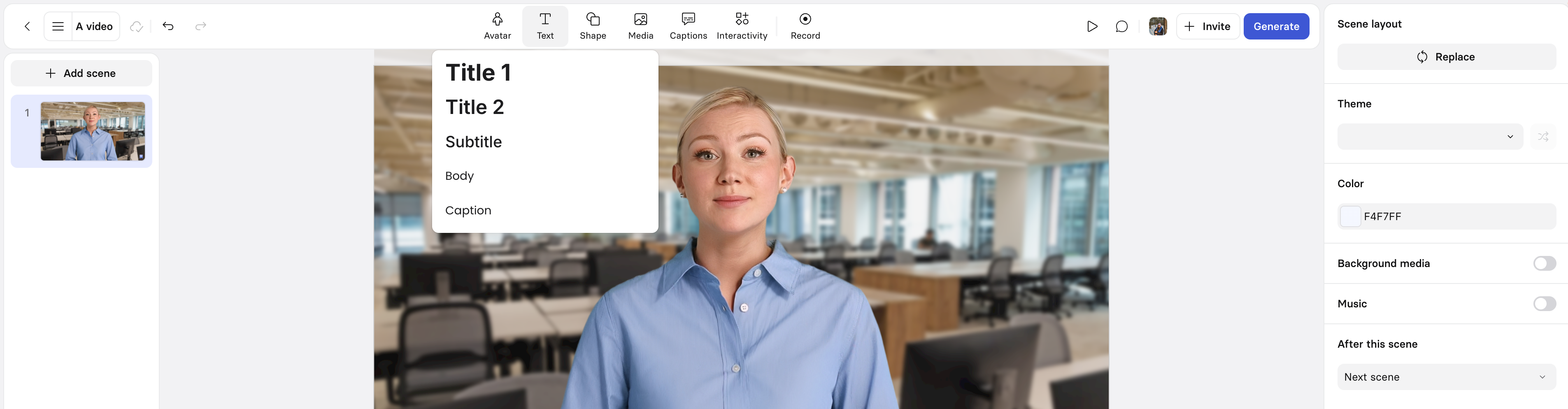
To add text to your scene:
- Select the text button in the top toolbar.
- Choose between Title 1, Title 2, Subtitle, Body, or Caption format.
- Drag and place the text box on your scene.
Text settings
To change the style of your text, select the text and use the Design tab of the inspector panel to customize it.
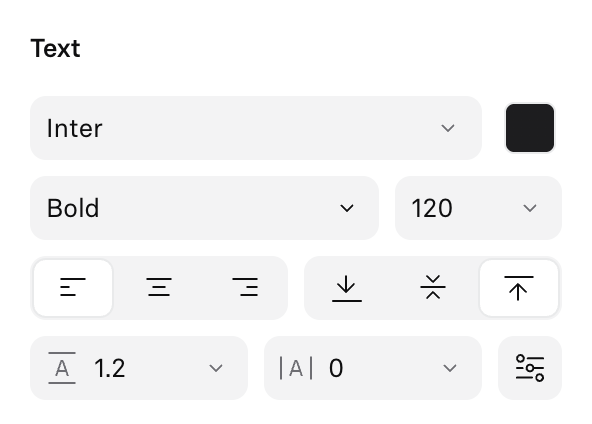
The Design tab gives you control over the following text properties:
Font family
Select the typeface for your text. Any custom fonts already uploaded to your workspace library appear in the list.
If the font you need isn't there, select + Custom font at the bottom of the picker to upload it:
- Select
Choose fontsand select a font file for a specific weight and style. Only upload fonts from the same font family at a time—Synthesia combines them into a single family for you. Supported formats: TTF, OTF, WOFF, and WOFF2. - Review your uploaded fonts. For each file, you'll see the font name, file name, weight (on a 100 Thin to 900 Heavy scale), style (Italic or Normal), and a preview.
- Each weight and style is a separate file. To add more, for example a Normal weight to go with an Italic you already uploaded, select
Add fontsin the top-right corner. - Enter a Font family name to identify the uploaded fonts, then select
Publish fonts to workspaceto make them available when selecting custom fonts. SelectCancelto discard the upload instead.
Font style
Choose the weight or style variant of your selected font (e.g., Thin, Regular, Medium, Bold, Heavy). Available options depend on the font family you've selected.
Text color
Set the color of your text. Selecting Text Color opens the Color picker panel—see Color picker below.
Horizontal alignment
Align your text horizontally within its text box. Options: Left, Center, Right.
Vertical alignment
Align your text vertically within its text box. Options: Top, Middle, Bottom.
Line spacing
Adjust the spacing between lines of text. Range: 0.5 to 3.
Letter spacing
Adjust the spacing between individual characters. Range: -0.5 to 0.5.
Type settings
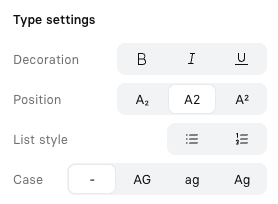
Access additional typographic controls. Selecting Type settings opens a sub-panel with the following options:
- Decoration: bold, italic, underline
- Position: subscript, normal, superscript
- List style: bullet or numbered lists
- Case: none, uppercase, lowercase, title case
Superscript and subscript are useful for trademarks (™, ®), footnote markers, and chemical formulas. Set them either by selecting Position in Type settings, or by pasting Unicode superscript and subscript glyphs directly into your text.
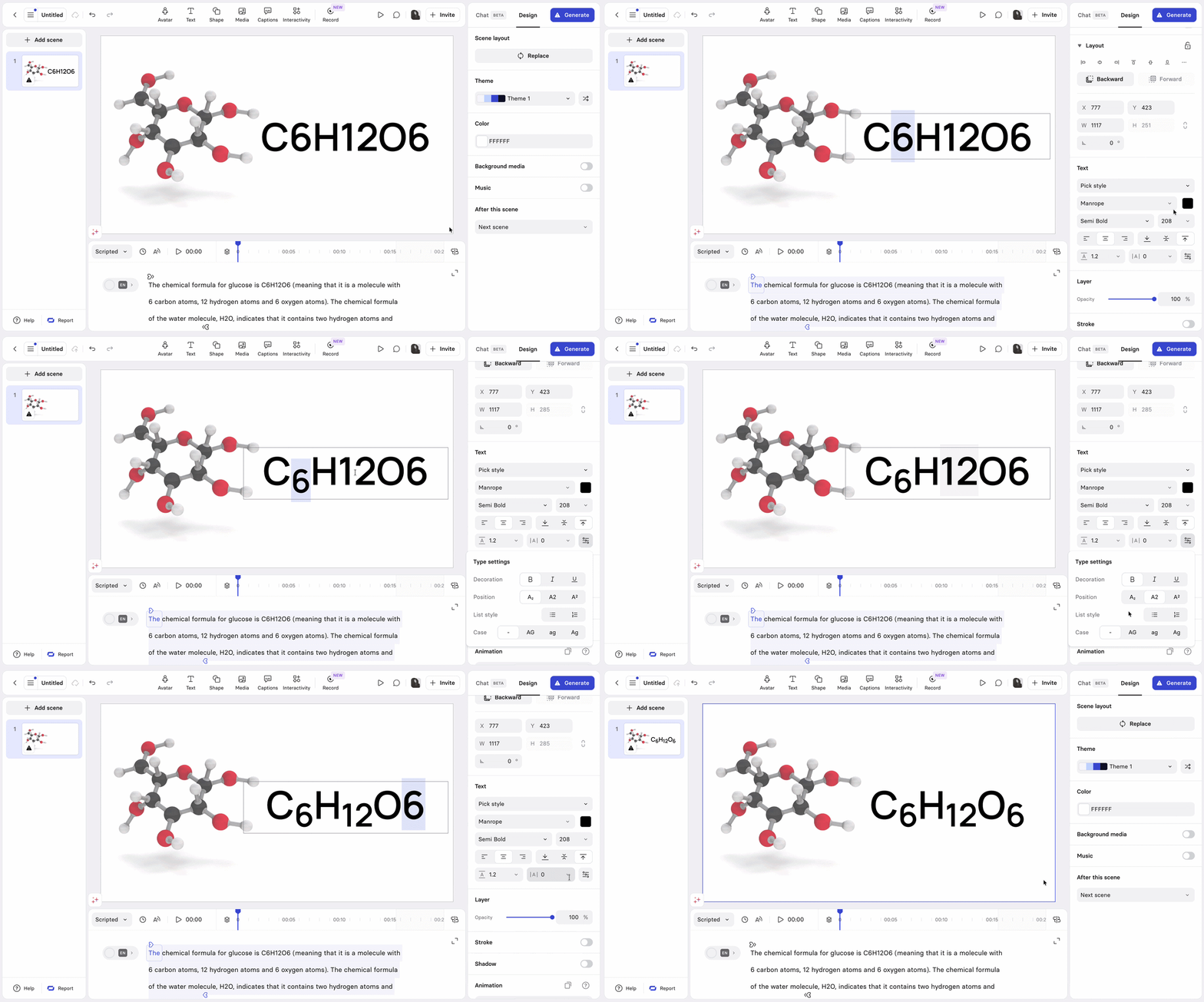
Note:Superscript and subscript aren't fully supported in the script box—only ® and © are. A chemical formula like C₆H₁₂O₆ still displays as plain C6H12O6 in the script and in captions.
Color picker
The Color picker opens when you select Text Color in the Text settings panel. Use it to change the color of your text.
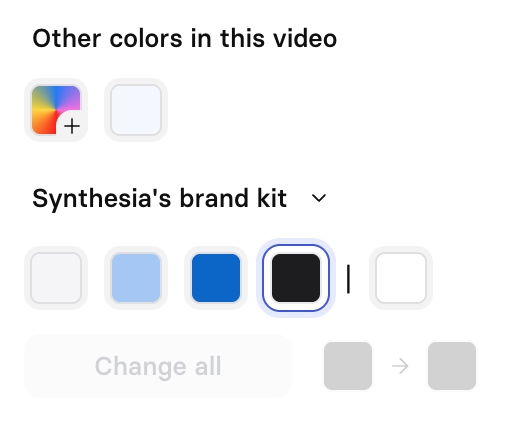
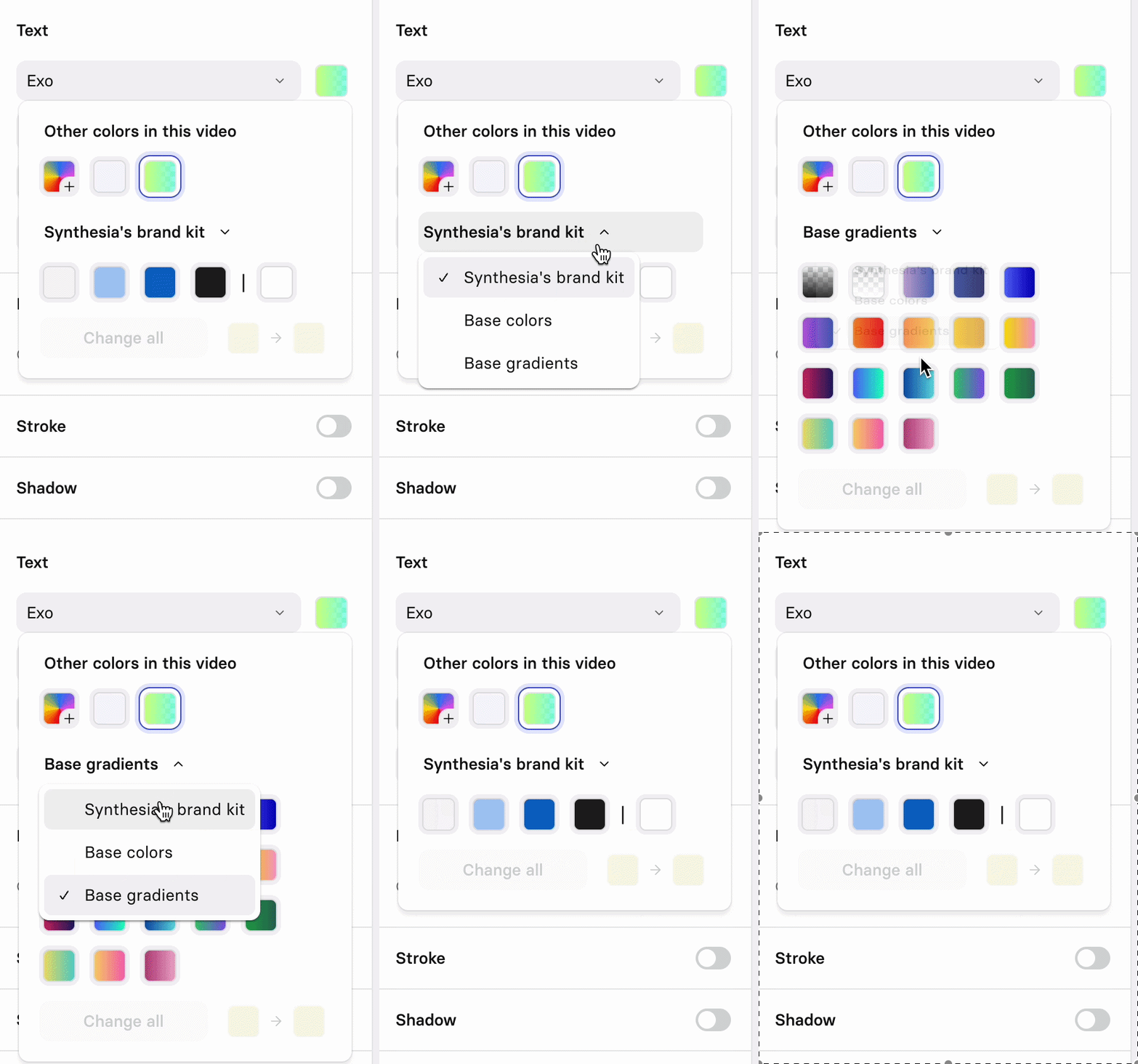
Choose between:
- Other colors in the video: Select from colors already used elsewhere in your video.
- Theme colors: Colors from your Brand kit, if enabled.
- Base colors: Default Synthesia color palette.
- Base gradients: Default gradient color palette.
Custom colors
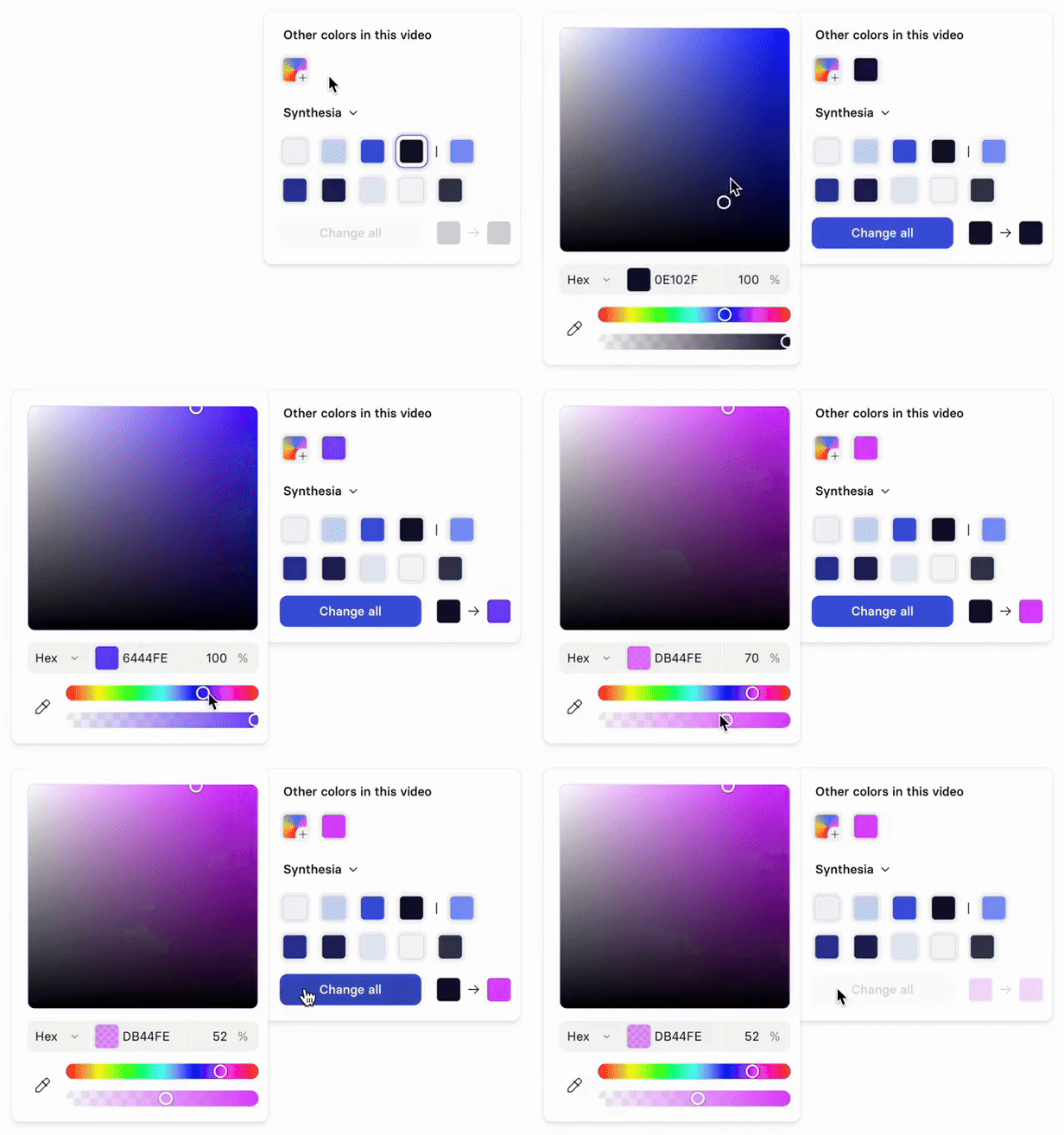
Select the edit color button to open the color selection window.
Solid color
Set a single color by:
- Using hex or HSL code, the color finder, or dragging across the color spectrum.
- Setting the opacity (0-100%).
Gradient colors
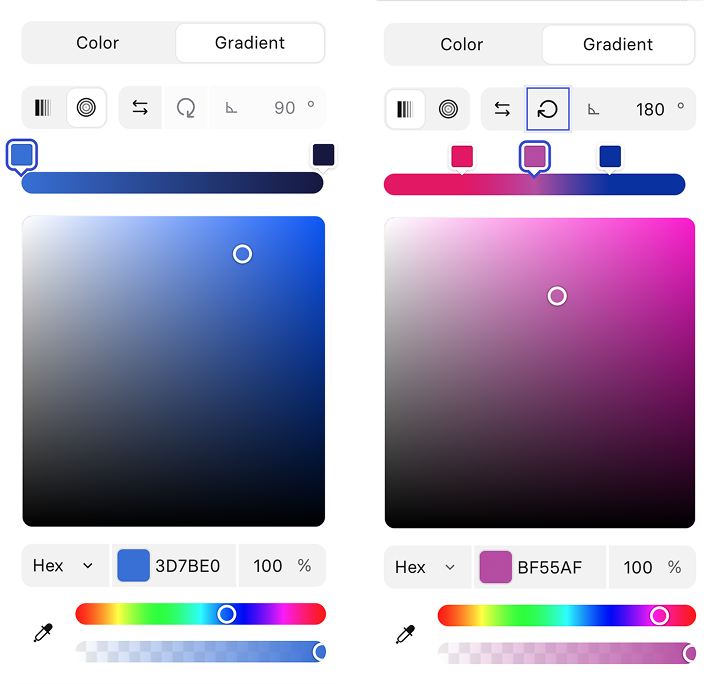
Apply a gradient across your text. Choose between a Linear or Radial gradient, then add up to 5 color stops:
- Select each stop's color using hex or HSL code, the color spectrum, or the color finder.
- Set the opacity (0-100%) for each stop.
- Drag a stop to reposition it, or past another stop to reorder them.
For a linear gradient, set its direction in degrees (for example, 0°, 45°, 90°, or 315°).
Note:A radial gradient is always a centered circle—you can't move its centerpoint or make it elliptical.
Updated 17 days ago